Showing posts with label Camberley. Show all posts

10 September 2025

I don’t want to be like my daddy : 1972 : Red Carpet Inn, Daytona Beach & ‘Baby Sitter’ by Betty Wright

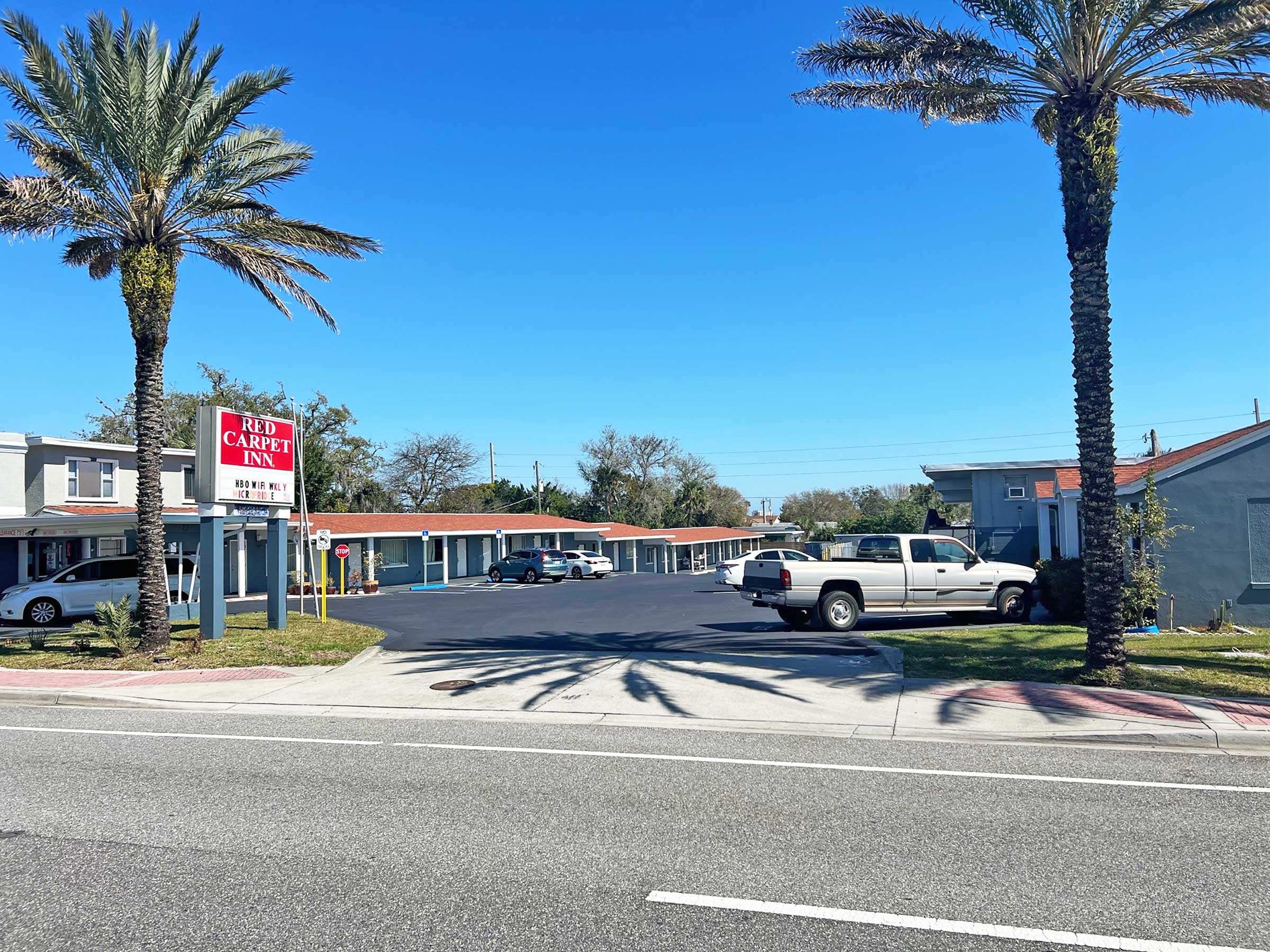
 Having answered the front door, its frame was filled by the 11pm silhouette of a large black man wearing overalls and carrying a toolbox. The only words I could discern from his Southern drawl were ‘air con’. Aha! He must have arrived to fix the air conditioning malfunction of which I had alerted the reception desk an hour earlier. He lumbered in and set to work while I continued to watch television.

“You on your own here, sir?” he asked whilst precariously balancing on a chair to grope the insides of the wall-mounted unit. Nobody had ever called me ‘sir’ before. I was a fourteen-year-old boy. He was at least three times my age.

“I am staying here with my dad,” I replied matter-of-factly. Was I meant to call him ‘sir’ too? He looked at me quizzically, seemingly not having comprehended my response. It suddenly dawned that, though Brits know American vocabulary from their TV and movies, Americans understand almost no British English.

“My father,” I clarified. “I am staying here with my father. But he has gone out this evening.”

“D’ya know when your pa gonna return, sir?” the man asked. I shook my head. I was not being coy. I did not know.

It took about a quarter-hour for the man to persuade the air conditioning to function again. Now, whenever I watch Robert De Niro fighting air ducts in ‘Brazil’, I am reminded of that maintenance man. Before he left, he kindly warned me:

“You’s be careful now, sir. And don’t you answer the door to anyone tonight as long as you is alone.”

I thanked him and continued watching television. My parents had raised me on the numerous 1960’s American shows broadcast in Britain, many of which were years old, so it was heavenly to binge on new episodes of familiar shows and those unknown to me. I had bought that week’s ‘TV Guide’ from the reception desk and was thrilled to discover shows like ‘Love American Style’ and ‘Room 222’ on ABC that made me laugh out loud, stretched out on my motel bed.

The late film that night was ‘The Magus’, a baffling watch despite the presence of Michael Caine and Anthony Quinn. Because American TV networks cut off movie credits, I had no idea that it was a critically mauled adaptation of a 1965 John Fowles novel. Back home, a female librarian at Camberley Civic Library had suggested I borrow Fowles’ 1963 debut ‘The Collector’, perhaps not realising from my height that I was only ten years old then, not a suitable age to read a harrowing account of a lonely young man kidnaping a girl and locking her in his cellar until she dies. For years after, I could not supress regular nightmares about this scenario … in which I was the young man.

A decade hence, university friend and housemate John Chandler would insist I read the paperback of ‘The Magus’. Despite the disappointment of the film, Fowles’ book proved to be riveting and not to give me nightmares. It remains one of my favourite reads, alongside another of John’s recommendations, Ursula Le Guinn’s 1974 novel ‘The Dispossessed’. I digress.

So where was my father that evening? I had no idea. He had left me in our motel room and driven away our hire car, promising to be back later. I eventually crawled into bed. He did not reappear until the next morning, offering neither explanation nor apology. As a teenage boy accustomed to parental indifference [see blog], I failed to recognise how irresponsible was his behaviour. Had the ‘Red Carpet Inn’ in Daytona Beach burnt to the ground that night with me inside, how would he have explained his decision to abandon me overnight 4,286 miles from home?

This whole father/son trip had been a bizarre undertaking from its outset. Unencumbered by prior discussion with me or my mother, he had visited a travel agency in Egham and booked a package tour to Florida for me and he alone, omitting our three other family members. My mother was understandably furious. My form tutor at school was furious as it meant me missing lessons for a week during term time and, henceforth, I was never awarded another School Prize [see blog]. Our first long-haul trip was ostensibly booked to witness the launch of the final Apollo rocket from Cape Kennedy. For years I had been a fanatic of the ‘space race’, following every event in detail and even corresponding with NASA for a primary school project. But my father was not.

Our father/son relationship could best be described as ‘business-like’. As soon as I could walk, my father had pressganged me into his one-man quantity surveyor business [see blog], me initially holding the end of his lengthy roll-out tape measure at properties, but more recently calculating returns on potential property developments [see blog]. Was this trip meant to be the reward for my decade’s unpaid service? My father had never seemed, er, fatherly to me. I do not recall him ever sitting me on his knee, holding my hand, hugging me or even reading me a book. When there was something he wanted to do that disinterested my mother, I was merely a handy substitute. Hence, despite my few years, I accompanied him to Camberley Odeon to watch ‘One Million Years B.C.’ in 1966 (aged eight), ‘2001: A Space Odyssey’ and ‘Planet of The Apes’ in 1968 (ten) and ‘Vanishing Point’ in 1971 (thirteen), the latter supported by a violent B-movie western in which a woman is stalked and raped by cowboys. Parental guidance, what’s that?

In the months between my father booking this trip and our departure, his behaviour had become more and more erratic, abandoning our family home for days on end without explanation. At the same time, he had become increasingly violent towards my mother, then caring for my months-old sister whom he had never wanted. Even though he had already indulged in purchasing a new American Motors Javelin sports car, he replaced it with an even more expensive and ostentatious two-seater ‘AMX’ model that resembled the drag racing cars he insisted on taking me to watch on weekends at nearby Blackbushe Airport. Was he experiencing some kind of mid-life crisis?

Whilst driving around Daytona Beach, I had noticed us pass a record shop which I wanted to visit. Having purchased my first soul single in 1969, I since had used pocket money to regularly buy imported American soul records from ‘Record Corner’ in Balham and ‘Contempo Records’ in Hanway Street. We stopped by the store and I bought some recent soul singles I had heard played on ‘American Forces Network’ Frankfurt, audible evenings in the UK on 873kHz AM, songs which had not yet been released at home: ‘Me and Mrs Jones’ by Billy Paul [Philadelphia International ZS7 3521], ‘One Life To Live’ by The Manhattans [Deluxe 45-139] and ‘Baby Sitter’ by Betty Wright [Alston A-4614].

After witnessing the delayed but spectacular night-time launch of Apollo 17 from the bonnet of our hire car, parked amongst hundreds of similar spectators, we caught our flight home from Melbourne airport. I felt sick and delirious that entire journey, unaware I was suffering sunstroke, my father having never considered providing me ‘sun creme’ or a hat during hours spent strolling together along the Florida shoreline for him to ogle bikini girls. Before our arrival home, he told me not to tell my mother about his unexplained overnight disappearances, our day of arrival having been the only night he had slept in his motel bed.

My silence made no difference because, only weeks later, my father left his family for good, similarly without explanation. Had the Florida trip been his clumsy way of bidding me farewell? Or had it been an experiment for him to explore a potential alternate lifestyle unencumbered by his wife and three children? Whatever it was, I did not miss him for one minute. All he had ever done was utilise my skills for his own ends. I did not shed one tear. For the previous fourteen years, he had only been present in my life when there had been some task I could do for him … rather than with him. Never had he demonstrated a genuine interest in his children.

Before he finally left, the few times he was at home, my father would play repeatedly the ‘Baby Sitter’ single we had brought back from Daytona Beach. It was a song in the Southern soul storytelling mould in which singer Betty Wright hires a teenage babysitter to look after her child, later discovering the girl has ‘stolen’ her man. The lyrics relate:

“This sixteen-year-old chick walked in

With her skirt up to her waist

She had a truckload of you-know-what

And all of it in place.”

Wright learnt the lesson after her man left:

“I should have been aware

Of the babysitter

I should have known from the junk, yeah

She was a man-getter.”

I felt it was a bit of a novelty song, nowhere near as classy as Wright’s 1971 ‘Clean Up Woman’ single [Alston A-4601] which I had purchased as an import single and loved. I had no idea why her new song seemed to resonate so strongly with my father until …

The day after my father left us, there was an unexpected knock on our front door. It was our friendly neighbour Mark Anthony who lived three houses along our cul-de-sac. He was visibly upset because his young bride had disappeared the day before without explanation. Had she contacted my mother, since we were the only family she knew on our street, the couple having only recently moved there? No, explained my mother, but my father had disappeared the same day. Oh dear! It seemed that my forty-one-year-old father had run away with Mark’s nineteen-year-old wife Suzie. She may never have been our family’s babysitter but she did resemble the girl in the song. I suddenly realised why my father had identified with its lyrics. He had abandoned us for a teenager. Was that how he had spent his nights in Florida?

During the months that followed, my father tried his utmost to destroy his family. While we were out, he would break into our home and steal as much as he could drive away of our possessions [see blog]. I lost a large number of soul records I had bought with my pocket money, many of which were irreplaceable and in which he had shown no previous interest. Amongst them was the ‘Baby Sitter’ single.

Years later, on the run from Court Orders requiring back-payment of thousands of pounds to my mother for the maintenance of his children, he fled to America. Eventually, the US Immigration Service caught up with him and expelled this ‘illegal alien’ back to the UK from Everton (population 133) in Arkansas where he had been confident/stupid enough in 1985 to register a business named ‘Andre Associates Inc’ with an address there at ‘Route 3, Box 68’, as well as a corporation of the same name in 1986 at '1608 Avalon Place, Fort Myers, Florida'. Extradited back to home soil, he disappeared again to Wales and then Christchurch. He never did pay his debts to us.

Upon his death in 2013, following who knows how many more failed marriages, my father left a handwritten will that bequeathed the bulk of his estate to my younger brother, along with his “collection of soul LP, CD, cassette music”. This was my apparent non-reward for having passed a decade working in my father’s business, whereas my brother had contributed not one day. I hope my brother has enjoyed listening to old records I had eked out of my teenage pocket money. Oh, I almost forgot, he had never shown any interest in soul music. To add insult to injury, my brother did not invite me to my father’s funeral, nor my sister, nor our mother. Evidently, he is the son of his father!

[I was reminded of these events whilst compiling my Spotify playlist of 2000+ 1970’s soul, funk and disco recordings from the catalogue of Miami’s ‘T.K. Records’, home to Betty Wright, George McCrae and KC & The Sunshine Band, amongst others. Naturally, it includes ‘Baby Sitter’.]

24 June 2024

Teach your children well? : 1960s-1970s : vegetable-free adolescence, Camberley

 “How often do you wash your face?” asked the doctor.

“Like how?” I responded, uncertain about what he was enquiring.

“You know, with soap and water,” he clarified.

“Er, never,” I replied truthfully.

“Why not?” he demanded.

“Because nobody ever told me I needed to,” I said, somewhat embarrassed.

The doctor regarded me pitifully, imagining I must belong to a tribe of itinerant gypsies or have been raised by wolves. To the casual observer, my suburban home life appeared quite normal. Scratch the surface and you would have discovered that my parents had given me few of the ‘life skills’ that are supposed to be demonstrated to children. On this occasion, my mother had sent her teenage son to the family doctor in Frimley Road because his face had become progressively covered in spots. But neither she nor my father had ever instructed me how or when to wash. Once a week, I stood under the water in our modern home’s shower cubicle. If my face became wet while shampooing my hair, I merely dabbed it dry with a towel.

The doctor wrote a prescription for a liquid called ‘Phisohex’ which came in a large green bottle. After a few weeks washing my face twice daily with this cleanser, my spots magically disappeared, following more than a decade of cheeks shamefully having been untouched by soap. Did my mother acknowledge this shortfall in her parental duties? Of course not. This was but one aspect of her ‘hands-off’ approach to childrearing. She had enjoyed a good post-war education at Camberley’s girls’ grammar school in Frimley Road where she was likely taught conventional housekeeping and domestic skills in preparation for marriage. She was goodlooking and always dressed immaculately in the latest trends. Her parents had raised her and her two sisters impressively. So where had her own parenting regime gone awry?

Most of the basic skills I developed – writing, reading, arithmetic – I learned from books and television rather than parental instruction. However, one ability that proved impossible to appropriate in that way was tying shoelaces. As a result, at junior school, after ‘PE’ (Physical Education) lessons that required us to change into slip-on plimsolls, I always had to seek out my cousin Deborah in the year below mine to ask her to retie the laces on my shoes. Once I progressed to grammar school, my skill deficit became more difficult to hide. The mandated school uniform required black lace-up shoes. My mother acknowledged my ‘shoelace’ issue but, instead of simply demonstrating how to do it, she bought me slip-on 'Hush Puppies' shoes for school which resulted in regular disciplinary action. Finally, I had to draft an embarrassing letter from my mother to the school, asking for her son to be excused from the dress code due to difficulty finding suitable lace-up shoes for his high in-step feet.

Like many 1960’s housewives, my mother regularly cut out recipes from magazines and stuffed them in a kitchen drawer. She was particularly proud of a plastic box with transparent lid holding two rows of Marguerite Patten recipe cards that she had sent for to ‘Family Circle’ magazine and which I was tasked with keeping in correct order. She loved making cakes and had a sweet tooth that probably promoted the development of diabetes in her later life. However, her skills with main meals were limited and she preferred to rely upon ‘instant’ foods like fish fingers that were heavily marketed to ‘busy’ housewives at the time. This was probably why I remained as thin as a rake during my childhood, despite teenage years spent scoffing two bowls of cereal both morning and night.

I had been a regular visitor to the family dentist on Middle Gordon Road due to the dreadful state of my teeth. Even at a tender age, I was being gassed for extractions. On one occasion, the stern dentist accused me of not brushing my teeth sufficiently firmly to prevent decay. I resolved to use the state-of-the-art electric toothbrush in our family bathroom with greater pressure during twice-daily cleanings. I returned to the dentist six months later, only for him to inform me that I had rubbed away most of the enamel from my remaining teeth. The outcome of his ‘advice’ was merely more extractions. Not once did this dentist question my mother about her children’s diet. Even if he had, she would have been unlikely to respond honestly.

My mother had an inexplicable lifelong aversion to vegetables. Only the humble potato would accompany our meals, usually in the form of Cadbury’s ‘Smash’. Carrots? Never. Peas? Nope. Broccoli? Unseen. There were other foodstuffs we never experienced – spaghetti, yoghurts, condiments, rice – because my mother had a preference for jellies, custard and blancmange, but it was the lack of vegetables that must have impacted our health growing up the most. I never understood how, despite the piles of women’s magazines around our home, she somehow studiously avoided taking their practical advice regarding suitable family diets. Such behaviour could have been excused earlier in the twentieth century when literacy and knowledge were less prevalent, but surely not by the 1960’s.

Much of my childhood during weekends and school holidays was spent at my maternal grandparents’ adjoining house where I helped prepare ingredients for their meals. Instructed by my wonderful grandmother, I would sit on the backdoor step with a bowl between my knees, shucking peas from their pods. I would use a peeler to remove the skins from various vegetables whose names I did not know. I would carefully place dozens of apples in rows within cardboard boxes, separating each layer with old 'Daily Sketch' newspapers before carrying them into the recesses of the house’s darkened larder under the stairs. My grandmother loved to make jams with these fruits, for which I carefully wrote out white adhesive labels carrying the manufacture date and type. Bizarrely, none of these vegetables or jams were ever served in our own house next door.

From the day she left school at twelve until the day she finally retired, my grandmother worked in fruit and vegetable shop ‘H.A. Cousins & Son’ at 11 High Street on the corner of St George’s Road in Camberley. During all those decades, her ‘sales assistant’ job never changed, standing all day on the shop’s bare floorboards, putting requested items in brown paper bags, weighing them on old-style scales against combinations of various brass weights, calculating the cost in her head and then the correct change to return to the customer.

Shop owner Mr Cousins would daily travel thirty miles to the fruit, vegetable and flower markets in London at the crack of dawn, returning with a van of produce to sell. Once a day’s stocks were sold, that was it. Any produce left over would be given to the shop staff. My grandmother regularly brought home quantities of all sorts of fruit and vegetables which she shared with us, though my mother always refused the vegetables. Thankfully, she did accept the fruit which became the sole source of my necessary five portions per day.

Cousins advertised its shop locally as “by appointment to Staff College” ('Sandhurst' Royal Military Academy), providing “Dessert Fruit and Flowers for Dinner Parties, etc.” Its upper-class customers and Sandhurst’s foreign residents necessitated it stock a variety of exotic fruits, the excess of which ended up in my family’s fruit bowl. Visitors to our house in the 1960’s were shocked to see pineapples, mangoes and lychees on our dining table, delicacies that I enjoyed as ‘normal’ long before their availability in supermarkets.

My mother insisted that fruit always be eaten covered in sugar, her favourite ingredient. Cups of tea required two spoons of white sugar, coffee two lumps of Demerara sugar, stewed apples or pears served frequently as our dessert had to be sprinkled with granulated ‘Tate & Lyle’. Even when I visited my mother in her final years, she would buy in a banana to offer me (she refused to eat them), accompanied by a plate of sugar in which to dip it. Thanks, mum. Banana yes, sugar no.

When my grandmother reached the statutory retirement age of the time, we all went round to her house for a little celebration of her departure from a lifetime of work on Cousins’ shop floor. She was pleased to be able to retire before Britain switched to decimalisation in 1971 as she feared metric calculations that no longer involved farthings, florins, half-crowns and guineas. Months later, the shop asked if she would return and work part-time because it was short-staffed. Of course she agreed. In total, she clocked up more than half a century working for that one employer in that one location, a 400-metre walk from her sole marital home.

In 1976, on arrival at university, the bulk of my Surrey County Council grant had to be paid in advance for one term of accommodation and three meals per day within college. Having never taken school dinners and rarely eaten out in restaurants, I was unfamiliar with the canteen system where you line up and tell the kitchen servers which food you want. I hardly recognised any of the foodstuffs on offer and would often merely opt for two identical desserts, skipping main courses entirely. Most intimidating were twice-weekly ‘formal dinners’ lasting an hour, during which more than a hundred students remained seated at long benches in the huge dining room to be served by staff a succession of courses completely foreign to me. The table places were laid with radiating lines of various cutlery, none of which I knew their specific purpose. My fellow students seemed to find all this ‘etiquette’, including ritual table-banging and foot-stomping, perfectly normal because 90%+ of them had grown up around such ‘practises’ at elitist private schools. I often avoided these ghastly events and sat in my room munching a packet of biscuits.

My parents having never taught me how to use cutlery, I had developed my own system whereby I always used my right hand to hold the fork. Only when I had to cut up some food would I transfer the fork to my left hand and then simultaneously use the knife in my right hand. The rest of the time, I placed the knife down on the table. Nobody had ever corrected me. Not until sitting in that university dining room, surrounded by loud toffs with posh accents and double-barrel surnames, did I have to learn to eat holding the fork in my left hand. To this day, my default way of eating is to grab the fork with my right hand. Old habits die hard.

In 1986, my little sister was offered a Saturday job on the till of a small self-serve fruit and vegetable shop in Camberley town centre. She was worried that she would not recognise the produce she would be expected to ring up, since our mother had never fed us veg other than potatoes. By then, I had spent a decade living away from our vegetable-free home and was able to accompany my sister on a ‘Secret Squirrel’ mission to the shop, during which we walked slowly around its one central aisle and tried to identify the varieties of common vegetable on sale. ‘Common’ to everyone else, particularly to our beloved late grandmother, but weirdly not at all to us!

In retrospect, my childhood must have been quite unusual because, although I lacked some basic life skills, I was steeped in other abilities beyond my age. By junior school, I had taught myself to type, to read music and play the piano (despite having non-musical parents). Having recruited me into his business once I could walk, my father taught me how to survey a property, create architectural plans on a drawing board, use Letraset, calculate floor areas and room volumes, prepare client invoices and statements on an electric typewriter, photocopy and make dyeline prints. Meanwhile, my mother enrolled me into reconciling her employer's accounts and calculating its staff's pay packets, pinning and cutting dress patterns to materials, basic knitting stitches, using her sewing machine and threading multiple yarns on her knitting machine. I was eight when typing the forms for my parents' passport renewals, testing my mother's knowledge for her driving test and testing my father for his pilot licence. By the time I started secondary school, I was holding the fort at my father's town centre office, learning shorthand from my mother's discarded 1950's text books and calculating potential profits of deals for my father's new property business. What a strangely un-childlike childhood it was!

30 April 2024

Attempted murder on the Waterloo express? : 1971 : Bagshot railway station

 Kapow! There was an explosion. Before I even grasped what had just happened, I could see I was covered with shards of glass. What was that noise? The train window I was sat next to had suddenly vanished and was in pieces on me and the seat. Luckily, I had not been looking towards the window at the time, otherwise my face would have been injured. Luckily, because it was winter, I was wearing an army surplus hat with furry earflaps that had protected my head and ears. Luckily, I was wearing a coat over my school blazer, gloves and long trousers that had shielded me, these winter woollies necessary because trains’ heating systems rarely functioned adequately.

I caught the ten-past-eight number 28 train every day for seven years from Camberley station to my school half-an-hour away in Egham. It was part of a commuter route propelling workers on the one-hour journey into London’s busy Waterloo terminus. Travelling to school this way felt like stepping into Narnia through the wardrobe door of our suburban British Rail station. Journeys were populated by strange characters not present in my normal day-to-day home life. The station platform was awash with bowler-hatted, suited gentlemen carrying leather briefcases and rolled-up umbrellas. Women were a rare sight. Humourless station staff in uniforms shouted announcements about delays in the tone of army drill sergeants. Bumptious Terry-Thomas ticket inspectors walked through train carriages, looking down their noses at our thick green cardboard season tickets as if we were interlopers on their Orient Express.

At least the trains on our line were relatively modern electric rolling stock. As a small child, I recall standing at the top of the open footbridge over Camberley station, looking down at the signal box beside the level crossing and feeling clouds of smoke envelope me from a steam train passing underneath. Or was that a ‘Railway Children’-inspired false memory, acquired from reminiscences by my grandfather who had worked unloading timber for local building firm ‘Dolton, Bournes & Dolton’ in the goods yard beside the station? He had been made redundant in the early 1960’s for the yard to be replaced by a new ring road and Camberley ‘bus station’, in reality no more than a line of bus stops and tiny shelters without a waiting room. After my afternoon arrival in Camberley by train to await the hourly 39B (40 minutes past every hour) or two-hourly 34A bus (15 minutes past even hours) for the final two-mile journey home, I would have to walk over to the railway station lobby and sit opposite the ticket window to keep warm and dry.

My schoolfriends and I were the Pevensie children of Camberley, rendezvousing every morning at the very rear of the station’s eastbound platform that could accommodate only four carriages, despite our train normally being eight. When the train driver pulled up close to the signal at the top of the platform, we could just about clamber up to open the first door of the fifth carriage from the platform’s sloping end. Those rear four carriages became our playground because, until the train reached Ascot station’s longer platform, we had that section entirely to ourselves. No other passengers, no train staff. We could be as loud and unruly as we wanted. We would walk down the corridor to sit at the very rear of the train because, eventually alighting at Egham station’s full-length platform, we would be right next to the exit gate.

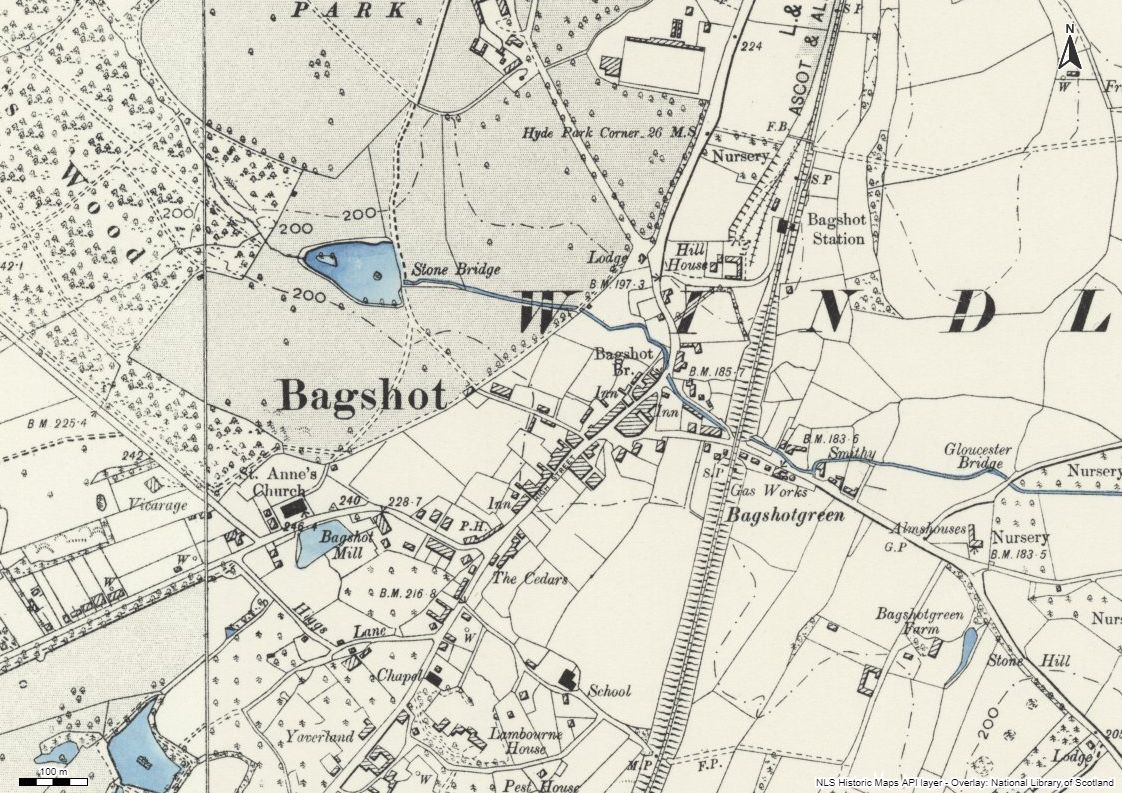
When the incident happened that morning, the train had slowed down to pull into Bagshot station and was about to cross the Guildford Road viaduct, a massively tall structure of four arches built in 1878. On either side of this bridge carrying dual train tracks were high embankments with steep, near vertical sides. On the north side, below the railway, was a vast tract of land owned by ‘Waterers Nurseries’ since 1829 to grow and sell plants. Before reaching that was Bagshot Infant School, set back from the embankment, on School Lane that ended in a footpath passing under the embankment towards Bagshot Green farm on the south side. At the time, undeveloped land stretched on both sides and (unlike now) the embankment was not bordered by trees.

Could a person have thrown a stone from the north side to make the train window next to me shatter? Unlikely because the embankment on which the train passed was too steep to stand upon. If the culprit had stood further away, below the embankment, a rock could not have reached the height necessary to make contact with the train, nor would it have retained sufficient momentum to smash the window with enough force for it to have not merely cracked, but to have shattered in its entirety.

What kind of projectile could have caused such damage? A powerful gun of some kind could have generated the necessary velocity and momentum for its bullet to shatter the thick glass window. A gunman (or woman?) would have needed practiced skill to aim upwards from the land below the embankment, or possibly to have lain half-way up the embankment adjacent to the footpath (now 'School Lane Field'). In either case, it would have required planning and experience to succeed in such a challenging topography next to the train route. Since only two trains per hour travelled in either direction, this act could not have been a spur-of-the-moment impulse.

Why was the window I had sat beside targeted? As the train decelerated to enter Bagshot station, the rear carriages would have passed at a slower speed, making them an easier moving target than the front ones. Us schoolboys were habitually the only passengers anywhere in those rear four carriages, making my head the one visible sign of on-board life amongst dozens of otherwise empty train windows. That implies that my window must have been purposefully selected as the intended target. It was a dark winter morning and the internal carriage lighting would have made my outline visible from outside the train.

So where did the bullet land? Only one thing was certain: it had not hit me, otherwise I would not be here to tell the tale. Did we look to see if a bullet had passed over my head and become embedded in the carriage’s structure? No. In that pre-‘CSI’ era, forensic science remained an unknown foreign land. From watching weekly television detective shows, all we understood was that ‘McCloud’ cracked cases by riding his horse down Broadway, ‘Columbo’ used his raincoat and ‘McMillan’ solved crimes by getting into bed with sweatshirt-wearing wife Sally. In the aftermath, I had not even deduced that I had likely been targeted by somebody shooting a gun. That is how unworldly I must have been, though I had always enjoyed the pellet-gun target shooting stall at the fair's bi-annual visits to Camberley Recreation Ground.

So how DID I react to this dramatic event? Did I scream? Cry? Sob uncontrollably? No, I simply stood up, brushed off the glass fragments that had covered me, and our little group moved to an adjoining carriage where the breeze through the vacant window would not make us feel colder. Even had we wanted to, there was nothing we could have done immediately. There were no train staff in those rear carriages and, once the train stopped in Bagshot station, its platform was too short to get out. Only once we reached Ascot was the platform long enough to deboard. So, did we? No, because if we had raised the alarm, we realised the fickle finger of fate might have pointed to us bunch of schoolboys for having broken the window. Which British Rail jobsworth would have believed our story that someone laying on a grassy knoll in Bagshot must have targeted me for assassination?

Leaving the train at Egham twenty-five minutes later, we could see the void where the window had exploded in front of our eyes. Nobody else seemed to have noticed the gaping hole or had bothered to halt the train to investigate. If they had, we might have arrived late for school that day. That would have been a fate worse than death. We had already brushed aside the incident and were more concerned with the school day ahead of us. Once I returned home that evening, I did not even bother mentioning to my parents what had happened. Only years later would I realise what a close call I had experienced that winter morning at the age of thirteen.

For us kids, trekking from one end of Surrey to the other every weekday on public transport, strange events would occur regularly in this otherworld. Our trains were sometimes cancelled, or rerouted through stations that were unknown to us, or suspended when someone jumped to their death off the footbridge at Egham station. In the latter case, some of us would watch morbidly for the arrival of emergency services whose crew had to scoop up the person’s bloodied remains spread along the tracks by a speeding train. Our unspoken attitude was: almost anything could happen on our way to and from school … and often did. It was a daily expedition into a world beyond ours, populated by weird adults to whom we appeared to be invisible.

Once a year, during ‘Royal Ascot’ week in June, our train would fill with bizarrely overdressed racegoers with strange toff accents and extremely loud voices who carried bottles of alcohol, swayed precariously and occasionally were sick on the carriage floor. They were much worse behaved than we had ever been, their conversations often ribald and filled with profanities. Did anyone chastise them, force them off the train or tell them to act respectfully in front of us children? Not at all! They did precisely what the upper classes are wont to do with their own children: they ignored us totally and appeared completely unembarrassed by their own behaviours.

I recalled the Bagshot train incident when, half a century later, I went for a run through rural France on a bright summer morning. There was no traffic and no visible human activity as I ran down the middle of a tarmacked road flanked on both sides by flat agricultural land. The only noise was birdsong until … a high velocity bullet whizzed above my head from left to right. I stopped running, turned in the direction from which it had come and shouted profanities (in English) at the top of my voice. Without my glasses, I was unable to see far enough into the distance to spot the culprit. This was no accident. I could not have been mistaken by a hunter for an animal. I was clearly visible on a ‘departmental’ road, not in the middle of woodland. But I had been the only object moving in this static landscape and that seemed sufficient to unwittingly make me a target.

If I were superstitious, I might be worried about ‘third time lucky’.

11 March 2024

You can’t tell me what I’m doing wrong… : 1976 : And Mother Makes Four, Camberley

 “Why are you choosing a university so far away?” aunt Sheila demanded of me. “You should commute from home to Guildford so you can help your mum.”

I was seething. It was the first time we had spoken in years and THIS was her ‘advice’ to me? How dare she! It was three years since my middle-aged father had walked out on our family to shack up with a runaway teenage bride [see blog]. Following his departure, he had apparently visited Sheila and poisoned her mind against her younger sister, my mother, so that the pair exchanged not one word for decades thereafter. Just when my mother had needed sisterly support to survive a difficult breakup and resultant hardship, Sheila had frozen her out. But she still felt able to tell me how to run my life?

There had been a time, between 1967 and 1969, when I had walked round to Sheila’s home every afternoon after school [see blog]. My parents had moved house, now too far away for me to simply catch a bus, so I would wait at Sheila’s between four and six o’clock until one of them arrived after work to pick me up. My lovely older cousin Keith would play me his Jimi Hendrix records on their living room stereogram until the arrival of his father from work at Solartron, a defence contractor in Farnborough. Suddenly, us children would be quickly ushered out into the garden (“Quick! I can hear his car,” Sheila would shout) or the kitchen if it was raining, because taciturn uncle Fred apparently required domestic solitude without the distraction of his three children (plus me). Even as a nine-year old, I viewed this household’s behaviour as bizarrely disciplinarian.

According to my mother, in the early 1950’s her father had forced a pregnant Sheila to marry Fred. That rift evidently never healed. Even by the 1970’s, when the couple and their children gathered with us at our grandparents on family occasions such as Christmas, Fred remained sat in his parked car on the street outside for hours, like a vampire uninvited to cross the threshold. A dozen of us relatives would be sat scoffing our dinner around my grandparents’ old wooden dining table, extended once a year by me pulling out its two extra leaves, while Fred was abandoned outside literally in the cold. It was a family feud that had started before I was born and which everybody since had politely ignored and refused to explain. Ours was a family at (passive aggressive) war.

How dare Sheila lecture me about my education choice! I had already been impacted by my parents having selfishly selected a secondary school at the opposite end of the county, saddling me for seven years with a horrendous commute that took at least two hours daily to journey home [see blog]. I had been denied a voice in that decision and paid the price, marooned so far from my school that I had not one local friend. Now this was MY time to determine MY future. Besides, nobody in our family had gained a school certificate, let alone attended university. Sheila worked as a ‘dinner lady’ at my former primary school. Upon marriage, Sheila and Fred were offered a post-war semi-detached council house on the Old Dean Estate where they remained their entire lives. I wanted more for my future than that.

When Sheila told me I should stay home to ‘help’ my mother, she had no idea what that ‘help’ had entailed during recent years or the toll it had already taken on my teenage life. As the eldest of three children in a newly single-parent household, I had to be the first to rise every weekday morning and the last to go to bed, usually after midnight. On top of a lengthy school commute requiring bus and train connections, teachers gave two homework subjects to fulfil every weekday night. My mother held down a full-time day job and an evening office cleaning job, requiring me to babysit my two siblings after school, as well as undertake ‘parental’ duties such as teaching my baby sister to read and write, along with hours of play on our living room floor. I thoroughly enjoyed providing her with the attentions that my parents had failed to offer me as a child, but my homework had to remain untouched until she fell asleep. (Daytimes during term time, while my brother and I attended school, our retired maternal grandparents generously looked after my sister at their house.)

The other aspect of my ‘help’ was the task of managing my mother’s financial and legal problems. When household bills and reminders arrived by post, she refused to acknowledge them, preferring to stuff them unopened into a drawer. To her, out of sight literally meant out of mind. I had to organise all her paperwork into folders, challenge incorrect charges, negotiate overdue payments and stave off court appearances and bailiffs. I corresponded with the government’s Inland Revenue tax authority, claimed benefits to which I discovered low-income families were entitled and visited the Post Office fortnightly to cash the ’Family Allowance’ voucher book. The volume of correspondence meant I soon became adept at forging my mother’s signature on letters and forms I prepared.

At the same time, I had to tackle the fallout from my parents’ separation and subsequent divorce. Without consulting me, my mother stupidly had decided, for the division of the couple’s assets, to appoint a local solicitor who had previously been used by my father in his erstwhile property business. The outcome was predictably disastrous. The court awarded her significantly less than half the value of the family home the couple had built themselves brick-by-brick in the mid-1960’s, along with no interest in her husband’s self-employed business in which she had undertaken all the bookkeeping for decades [see blog]. It rested with me to sit in libraries, searching through legal texts until I could prove her solicitor had failed to adequately represent my mother’s interest. I then made after-school appointments with a brace of legal practices nearby, meeting each puzzled solicitor in my bottle green blazer, until I found one who was prepared to initiate action against a fellow lawyer for breach of Law Society rules.

This was the ‘help’ I had been providing my mother the last three years. Although aunt Sheila had been invisible during that time, her eldest daughter Lynn had volunteered to be fairy godmother to me and my siblings, virtually living at our house, cooking meals and looking after us while our mother worked. I had recently been forced into my first ill-fitting suit to attend her church marriage to a salesman for ‘Smith’s Crisps’ (proud of his company car!). Having no children and no longer working, Lynn became the sensible adult sister our hard-up family had never had and made an immense difference by keeping us alive and together during those difficult times. Her invaluable contribution during our hours of need has never been forgotten.

Aunt Sheila had failed to understand that my reason for going away to university was to reduce the burden on my mother’s precarious finances. At the moment, her earnings were having to pay for my upkeep. My father had been ordered by the court to provide maintenance payments for his children but he was forever in massive arrears. Another of my jobs was to phone Farnham County Court once a month (which necessitated arriving late for school) to remind its clerk that my father’s payments were months behind and he needed to be threatened. It was a fruitless task. Worse, on my sixteenth birthday, my cruel father had petitioned the court to reduce my maintenance payments to £1 per annum on the grounds that I should take a job. The stupid court agreed, oblivious of my goal to obtain the education my parents had never had.

I had already made attempts to reduce the financial burden. The local council was now paying for my termly railway season ticket to travel to school (but not for the buses). My mother had always prepared sandwiches for me to take in a Tupperware box for my lunch. To cut this cost, I applied for free school lunches, something I had never eaten before. Eventually the school agreed, I entered the dining room for the first time but the staff forbade me to sit on the benches with my classmates. Instead, I was ordered to sit at a tiny table in the corner of the room with three other boys from lower years (out of a school of 300) who were similarly entitled to ‘free school meals.’ I argued that this policy was discriminatory against us ‘poor’ students. I was told where to go. That became my first and last school dinner. I had to return to taking sandwiches.

Attending university away from home meant that I would receive a ‘full grant’ from Surrey County Council that included my costs of accommodation and travel there and back each term. I realised how expensive living costs would be in London so I had to rule out applying to universities there. That left plenty of institutions across the rest of the country. There would be downsides to moving away. I knew I would miss my family terribly, particularly my little sister whom I had looked after from a baby to become a smart, lively four-year old. There had been a time earlier in her development when she had invented her own non-English words for everything and my presence had been required by our family to ‘translate’ what she meant. My mother had even taken her to the doctor, fearing a speech problem, but she eventually grew out of that habit.

Speaking to me the way she had, aunt Sheila appeared oblivious to our family issues. She was equally oblivious to the fact that universities had to choose YOU, not the other way around. To me, at that time she seemed to inhabit a safe suburban bubble. Whereas, since my father’s departure, our family was being tossed around by circumstance, never certain of what further calamity might arrive around the corner. I could not explain all this to Sheila. I was livid with what she had said but I just walked away. Despite me having had to assume domestic responsibilities beyond my teenage years, she had chosen to address me in such a condescending adult tone. Why did she seem in thrall to my dreadful father who was so eager to make life as difficult as possible for his former family? I never understood.

Once I had completed my first term at university [see blog], I bought a Kenwood food mixer for my mother for Christmas, to replace the broken one she had been gifted in the 1950’s and treasured. As a small child, she would offer me its ‘K’ shaped mixing element to lick off the excess cake mix. This was the most expensive present I had given her, having saved up through miserliness with my initial student grant. I was pleased to be contributing financially to our household for the first time, rather than being a financial burden. Now, at the end of each term, I would arrive at my mother’s home and have to spend the first few days answering all the bills, demands and legal threats she had ignored and hidden away during previous months. Somebody had to do it. Sometimes it felt as if my life might never be my own.

These days, on the rare occasion I hear the brilliant number thirteen pop chart hit ‘Captain of Your Ship’ by ‘Reparata & The Delrons’, I am transported back to 1968 when I would sing along with the kitchen radio tuned to ‘BBC Radio One’ in Sheila’s house after school. Good times never seemed so good.

27 February 2024

Land of a thousand cockroaches : 1986-1987 : Deptford Housing Co-operative, London

 “Gimme your money!” he shouted, pointing a pistol at me. He had jumped out from behind some bushes. It was a dark winter evening. I was alone. Nobody was about. I was ten metres from the entrance to New Cross railway station, about to return home, having walked my girlfriend to her train after an evening together. Street lighting beyond the railway was abysmal. I jumped with surprise. It was my first mugging. It was my first year living in London. I was aware of the advice: hand over your wallet and do not argue. I knew the fate of Thomas Wayne.

Except that I had no wallet to give. I had a five-pound note in the left pocket of my black Levi 501’s and some loose change. That was it. No credit cards. In London, I knew to carry as little as possible. I had not carried a wallet since an embarrassing incident in 1978 when I had parked my little yellow Datsun at the end of Upper Gordon Road, opposite Elmhurst Ballet school, and walked into the town centre. Within the hour, I returned to the car and drove home, only to receive a phone call from Camberley police station. Somebody had picked up my wallet from the gutter and handed it in. It must have fallen from the side pocket of my jacket as I stooped to enter the car. I had no idea it was missing. I collected the wallet and found it intact. I have never forgotten that anonymous ‘good Samaritan’. After that, I gave up carrying a wallet.

Later that same year, I had robbed myself through carelessness as a twenty-year old student union vice-president. Following an extensive survey of the photocopier market, having used such machines since the 1960’s [see blog], I decided that the Rank Xerox 3600 was the most modern and robust to rent and install on the mezzanine level of the student building in Durham. Once the company’s technicians had set it up and departed, I was so keen to test it that I wanted to make the first copy. However, I had not been carrying any papers so I reached into my pocket and pulled out the only banknote I had. It was £50 because, in the pre-debit card era, I would withdraw £100 monthly from Lloyds Bank’s cash machine opposite Dunelm House. I put the note on the platen, pressed the button and out came a perfect monochrome copy which I then rushed off to let my peers admire. Minutes later, I realised I had left the £50 note in the machine and returned to find it … gone. The copier’s first student user must have been delighted!

Now, accosted in the shadow of South London 24-storey high-rises, within seconds I had to decide how to react. I had no wallet. If I were to offer my meagre five-pound note, this highwayman might become angry and violent. It was never a good idea to argue with a man pointing a gun at you. I stared at my mugger, his face mostly hidden by a blue bandana. He was barely five feet tall. Was he even an adult? 1981’s ‘Stand and Deliver’ music video flickered in my head (no relation). I recalled childhood streets that encompassed Gibbet Lane where, times past, robbers like him on the main road to London had been hanged. I took the rash decision to simply turn and walk away … briskly. I might be shot in the back. I might be attacked from behind. My heart was beating so fast but I knew not to break into a run. And, incredibly luckily, nothing at all happened.

Home was five minutes’ walk away. On the payphone inside the front door, I immediately called 999 to report the incident. While I was sat waiting in the kitchen for a police officer to arrive and take my statement, one of my female co-tenants arrived. I explained breathlessly what had just happened. She quietly recounted that she had suffered the same experience in precisely the same place, a few days previously, and had been relieved of her handbag. Had she reported the robbery? No. I was aghast. Why not? I waited several hours, no police arrived. In the weeks and months that followed, my crime report was never followed up. I lost my faith in ‘the Met’ that night.

What the hell was I doing living in this rundown, sometime scary part of London? It was desperation. In January 1986, I had taken my first job in London, managing a job creation scheme at ‘Radio Thamesmead’ [see blog]. The daily commute by coach and multiple trains from my mother’s home in west Surrey to southeast London was hellish, consuming four to six hours per day. My government pay was too low to afford private rented accommodation in London. Neither could I register for council housing because I was not already dwelling in a London borough. I consulted ‘Yellow Pages’ directories in Camberley library and typed individual letters to every housing co-operative in London, enquiring whether I could rent a room. There was only one encouraging reply, from ‘Deptford Housing Cooperative’, telling me it would contact me when a place became available.

Months passed without a word. I wrote again. I was invited to a meeting. I was eventually offered a three-metre by three-metre room in a ten-person house at a reasonable rent. I took it. My travel-to-work time was cut from hours to minutes and my cost to very little as I was journeying the opposite direction to suburban commuters. The morning trains I was now taking to work were almost empty, whereas I would never forget my first day at Radio Thamesmead when, changing trains at London Bridge station, I had been knocked down the staircase of platform six by a hard briefcase wielded like a battering ram by a descending bowler-hatted gentleman. It had been my first lesson in commuter rage.

Some of my nine new housemates were lovely, some not quite so. Before my arrival, they had jointly decided at a ‘house meeting’ to rent a colour television from ‘Radio Rentals’ but, within weeks, it had disappeared one night from the living room, allegedly stolen and fenced by housemate Knollys. There were characters. One young bearded dropout seemed to model himself on ‘Citizen Smith’, railing against capitalism whilst living on benefits, wearing a denim jacket covered in badges and smoking roll-your-owns. One young woman attended a friend’s Berber wedding in the mountains of Algeria and returned with amazing photos and stories.

My room in the house was thankfully dry and secure, though somewhat noisy as it was adjacent to the railway line. However, I quickly learned never to use the ground-floor kitchen. Switching on the kitchen light triggered a loud sound like the noise of a receding wave washing pebbles down a beach. I learned it was made by cockroaches scuttling to hide from the light, a phenomenon new to me. Not dozens of them. Hundreds! We contacted the housing manager who ordered a pest control specialist to come and fumigate the kitchen. Days later, the noise was still occurring. If you opened any kitchen drawer, you could watch them scatter.

A further visit by pest control was organised. This time, the kitchen and adjoining living room were fumigated simultaneously and cordoned off-limits for a whole day. We were more hopeful. But hope proved not enough to kill the vermin. Within days, the expert had to be recalled to examine our evidence that bugs were still present in massive numbers. He looked. He saw. He told us: “the only way to get rid of so many of them would be to demolish the building”.

Demolition was not going to happen. Our house was in the middle of a terrace of eight three-story units on Rochdale Way that had only been constructed in 1978. Yet already our unit should have been condemned as unsanitary. But notification to health inspectors would have made all ten of us homeless. Instead, we suffered the bugs and I saw some housemates continue to use the kitchen for preparing meals, despite the evident health risk.

Filth and crime quickly became my initial impressions of London living. When my cassette deck developed a fault, I returned it to the closest branch of ‘Comet’ in nearby Lewisham which agreed to repair it under guarantee and return it within a fortnight. A month later, I was still waiting. The shop stonewalled me for a few weeks more before admitting that its lorry, with my equipment inside, had been stolen. Would I accept a brand-new replacement? Yes, I would and selected a top-of-the-range model that would substitute perfectly for my vanished bottom-of-the-range purchase.

After having started work in Thamesmead in January 1986, it had taken until September for me to be offered this room in Deptford, six miles away. However, my one-year work contract there ended in December, after which I took a seasonal job at ‘Capital Radio’ in central London [see blog]. Then, in the new year, I started a long commute three days a week to work at ‘Ace Records’ in Harlesden, twice as far away on the opposite side of the city [see blog]. Once again, most of my earnings were being spent on travelling to work. I would have saved more money if I could have used my house’s kitchen, rather than having to buy takeaway meals every evening.

It was time to find somewhere to live nearer my new workplace, hopefully a self-contained flat rather than another house share. My one year in Deptford had proven interesting – Deptford High Street market, Pearly kings and queens, Jamaican patties, second-hand record shops, pirate radio, nearby Greenwich Sunday market – but it would be nice to sleep soundly without worrying whether thousands of cockroaches could climb the staircase overnight to invade my bedroom. I started buying the weekly ‘Willesden Chronicle’ local newspaper from the stand outside Harlesden station to scan the small ads. Presently, my house was not a home.

29 January 2024

My thwarted career as teenage reggae music journalist : 1972 : Jamaica

 I blame Jesse James. Though cowboys and westerns held zero interest for me, something about the record ‘Jesse James’ appealed, much as an Israeli novelty song ‘Cinderella Rockefella’ the previous year had possessed sufficient charm to become my first ever vinyl single purchase. Now, having heard this reggae tribute to the outlaw played on ‘BBC Radio One’ or ‘Radio Luxembourg’, I placed my order at the record counter on the first floor of ‘Harveys’ department store in Camberley and, within a fortnight, it arrived. There was no song, merely Laurel Aitken shouting "Jesse James rides again" with gunshot effects over an incessant rhythm. Nevertheless, I had just purchased my first reggae record [Nu Beat NB 045] and I loved it. It was 1969.

After that, my reggae buying accelerated as fast as pocket money would permit. There was the intriguing instrumental single ‘Dynamic Pressure’ [London American HLJ 10309] recorded at Federal Studio, but so-named as the original had been cut by Byron Lee at his Dynamic Studio. I inexplicably bought the terrible cover version by Brit studio band The Mohawks of ‘Let It Be’ [Supreme SUP 204] for reasons I cannot recall. A recently opened second Camberley record shop in the High Street displayed a rotating stand of reggae albums from which I bought ‘The Wonderful World of Reggae’ [Music for Pleasure MFP 1355] because it cost only 14/6 for twelve tracks. I had been unaware it actually comprised (half-decent) cover versions by London session musicians of recent reggae songs heard on the radio.


In 1970, I bought several reggae singles that had reached the UK charts, including ‘Young Gifted and Black’ [Harry J HJ 6605], ‘Montego Bay’ [Trojan TR 7791] and ‘Black Pearl' [Trojan TR 7790], all of which I was to discover later were cover versions of American songs. During this era prior to Jamaican sound engineers’ creation of ‘dub’, most B-sides were straight instrumental ‘versions’ of their A-sides. However, it was the occasional exceptions that offered my earliest insight into the remarkable creativity and fresh ideas issuing from Jamaica’s (and London’s) recording studios:

The B-side of ‘You Can Get If You Really Want It’ [Trojan TR 7777], a straight cover of Jimmy Cliff’s song, was a Desmond Dekker original ‘Perseverance’ with great lyrics over an amazingly fast rhythm track that came to unexpected abrupt halts. I still love it more than the A-side.

The B-side of ‘Leaving Rome’ [Trojan TR 7774], an exceptionally haunting instrumental laced with strings, was another instrumental ‘In the Nude’ with trumpet player Jo Jo Bennett double-tracked improvising over an urgent rhythm. This must have been the first ‘jazz’ recording I had heard and I loved it.

The B-side of ‘Rain’ [Trojan TR 7814], a cover of the Jose Feliciano song, had ‘Geronimo’ wrongly credited to singer Bruce Ruffin but consisted of a man shouting "Geronimo" and "hit it", echoed over a rhythm I later learned was by UK band The Pyramids. It was bizarre but fascinating.

Most significant was the B-side of ‘Love of The Common People’ [Trojan TR 7750], another cover version with a string arrangement overdubbed in the UK by ‘BBC Radio 2’ doyen Johnny Arthey’s orchestra. The instrumental ‘Compass’, credited to producer Joe Gibbs’ studio band ‘The Destroyers’, could not have been more different than the unrelated smooth A-side. It literally changed my life. Essentially it was a jazzy solo saxophone workout, but over an instrumental track drastically different from anything I had ever heard. The walking bass was turned up loud but had been deliberately dropped out of the mix on occasions. The continuous rhythm track had been filtered to leave only its high frequencies and then echo added, making the result impossible to determine which instruments were playing. The whole thing was bathed in enough reverb to sound as if was recorded in a bathroom.

For me, ‘Compass’ was a really radical production, emphasising the bassline and using studio effects to contort other instruments into sounds that were unrecognisable and ethereal. The sound engineer (likely Winston ‘Niney’ Holness at Gibbs’ studio in Duhaney Park, Kingston) had transformed a typical reggae rhythm track recorded (for an unrecognisable song) onto four-track tape into something completely different and incredibly creative, using only a standard mixing desk and some basic electronic effects. It was the first example I had heard of a ‘mix’ that had not tried to reproduce musical instruments as they sounded naturally, but to have deliberately distorted them into unnatural noises that created a whole new audio experience. It was the first track I had heard that stripped a recording down to so few elements: a pumping bass, a bizarre ultra-tinny ‘clop-clop’ rhythm and a booming saxophone. ‘Compass’ was a harbinger of ‘drum and bass’ mixes which reggae would soon pioneer (the first occasion I saw this term used was the B-side of Big Youth’s 1973 single ‘Dock of The Bay’ [Downtown DT 497]).

More than anything, it was ‘Compass’ that hooked me onto reggae at the age of twelve. I played that B-side at home hundreds of times but was desperate to hear more recordings like it. Not easy when you live thirty miles outside of London. Instead, my reggae research started in earnest. From the ‘Recordwise’ record shop owned by Adam Gibbs opposite my school in Egham [see blog], I collected weekly new singles release pamphlets distributed to retailers and stared longingly at the many titles of new reggae releases, more of which were issued in the UK during this period than all other music genres added together. I joined the shop’s ‘record library’ which loaned vinyl albums to customers for a fortnight for a small charge. I soon ‘worked’ in that shop during lunchtimes as my knowledge about popular music was becoming encyclopaedic. But, above all, I became obsessive about reggae.

I wrote to ‘Trojan Records’, one of London’s two major reggae distributors, requesting information and was invited to join the newly created ‘Trojan Appreciation Society’ run by two female fans. For my subscription fee, I received monthly Roneo-ed newsletters, some free records and a huge gold metal medallion imprinted with the company’s logo attached to an imitation gold chain, which I wore to school every day under my white school shirt and striped tie for the next five years … until the gold paint had worn off on my chest. I had a fold-out double-sided A2 sheet of all Trojan’s past releases, listed by each of its myriad of weird and wonderful record labels, which I would peruse in awe for hours. I so wanted to hear all this wonderful music, but how?

My luck was in. I was already an avid fan of ‘BBC Radio London’ when it launched Britain’s first ever reggae radio show, ‘Reggae Time’ hosted by Steve Barnard on Sunday lunchtimes. To the chagrin of my mother’s attempts to serve our family’s Sunday dinner, I would sit listening with headphones plugged into our hi-fi system, cataloguing a list of every record played each week from the very first show, recording songs onto cassettes. It was my much-needed window into the world of reggae and enabled me to enjoy almost two hours of new releases weekly, interviews with artists and dates of sound system events (inevitably all in London). Doing my homework on weekday nights, I would listen to my cassettes over and over again until I knew the songs by heart. From then, my pocket money was used to buy less well-known reggae records beyond those in the charts and played on mainstream radio. My personal reggae ‘wants list’ inevitably grew longer and longer.

Somehow, I discovered the existence of a music and entertainment magazine published in Jamaica named ‘Swing’. I may have finally identified its address in an international publishing directory in the local library, sending them cash for a subscription and henceforth received monthly copies by air mail. Along with interviews and features, it published advertisements for record shops and record labels in Jamaica, offering a first-hand insight into the island’s reggae industry. I devoured each A4 colour issue and treasured them like valuable artefacts.

My parents’ hands-off attitude to childrearing allowed me to pursue my interest in reggae without interference. From the Camberley High Street record shop, I bought another 1970 compilation ‘Tighten Up Volume 3’ [Trojan TTL 32] for 15/6, this time comprising twelve amazing original recordings. It became the first of many album purchases on ‘Trojan Records’. When I Blu-Tacked onto my bedroom wall its daring poster of a full-length naked woman daubed with the album’s song titles, my parents did not even blink. My mother even liked some of the reggae records I played loudly on the hi-fi system in our open-plan living room, particularly ‘Leaving Rome’.

In 1972, my father announced that he had booked a family winter holiday for the five of us to Jamaica, paid for with cash proceeds from dodgy property deals with his latest business partner Bill Beaver [see blog]. He had shown no prior interest in my music and probably had no idea this was where reggae originated. It was just a lucky coincidence. Until then, the furthest our family had vacationed was Spain [see blog], making this our first long-haul destination. I was over the moon. While my family sunbathed on the beach, MY objective would be to travel to Kingston and explore the reggae music industry. I started to write out an address list of all the recording studios and record shops whose names I had found printed on record labels, album sleeves and in ‘Swing’ magazine.

As an avid reader of Charlie Gillett’s column in ‘Record Mirror’, I had ordered his 1970 book ‘The Sound of the City’ and been amazed to realise it was possible to write about popular music in a scholarly and meticulously researched format. Establishment voices then considered ‘pop music’ frivolous and worthless, condemning it as ephemeral, while their favoured classical music was deemed valuable and enduring. Gillett’s paperback opened my eyes, became my musical ‘bible’ for years to come and changed my life’s direction. I wanted to write about reggae in the same passionate yet factual way that Gillett had documented American black music so brilliantly. I already knew the names of reggae’s producers, recording studios, record labels and artists. A ‘research’ trip to Jamaica would complete the jigsaw puzzle.

I owned a Bush portable cassette recorder with microphone I would take with me to record interviews. I had a Kodak Instamatic camera and I might be able to borrow my father’s Canon Dial 35mm camera. Although I had no contacts in Jamaica, my plan was to find and hang out at the addresses I had researched. At that time, almost no journalist in Britain was writing about reggae music. Although I lacked formal training beyond my English GCE, I was already a competent writer and believed, on my return to Britain, I could approach music publications to interest them in my unique content. I could be a young reggae music journalist. I might have been a naïve fourteen-year-old, but it seemed an exciting prospect.

Then, weeks before we were due to fly to the Caribbean, my father suddenly told us he was leaving our home [see blog]. I had observed my parents’ relationship recently dogged by shouting, arguments and violence, but he offered no explanation of where or why he was going. Only afterwards did we learn from our gobsmacked neighbour Mark Anthony that my father had run off with his recent teenage bride to set up house in a posh part of Weybridge. As suddenly as it had been announced, our family holiday to Jamaica was withdrawn. My father did take the vacation, but without his (former) family and instead accompanied by who knows. I was left with my list of Jamaican addresses and a working holiday plan that was in tatters.

In the years that followed, reggae was suddenly ‘discovered’ by the mainstream music press that sent journalists, sometimes knowing next to nothing about the music, to Jamaica to report on the industry there. Weeklies ‘NME’ and ‘Melody Maker’ splashed reggae artists on their front covers. More knowledgeably, Carl Gayle wrote excellently in the ground-breaking ‘Black Music’ magazine launched in December 1973. Dave Hendley started a ‘Reggae Scene’ column in fortnightly ‘Blues & Soul’ magazine. An amazing A5 fanzine ‘Pressure Drop’ was launched from Camden in 1975 by Nick Kimberley, Penny Reel and Chris Lane with a penchant I shared for lists, such as its original discography of Big Youth singles.

I read all these writers’ reggae articles avidly and was pleased to see my favourite music now exposed to a wider audience. However, my appreciation was tinged with sorrow that I had no involvement in this ‘movement’ despite the knowledge I had acquired since buying my first reggae record in 1969. It was hard not to occasionally entertain the jealous notion that 'it should have been me' (as the song goes). Instead, my time and resources were diverted by unexpectedly bearing the mantle of eldest of three siblings in a one-parent family while my mother held a full-time day job and cleaned offices during evenings [see blog]. My ambition to write about reggae had to be put on hold until attending university in 1976 … by which time reggae music had suffered press overkill and ‘punk’ was the next big thing.

My passion for reggae continues to this day. Listening to ‘Compass’ now still makes me shiver. Four decades after buying that single and playing it to death, I accidentally discovered its original vocal version was ‘Honey’ by Slim Smith [Unity UN 542], a truly unremarkable song that had masked a remarkable rhythm track. For me, that remains one of the enduring wonders of discovering reggae’s multiple versions.

[Click on the record labels to hear their music. I curate several reggae playlists on Spotify.]