27 July 2024

Caribbean drubbing on such an “Armageddon-like” day : 2024 : Hurricane Beryl, Carriacou

 "Clackety-clack clackety-clack, from Kalamazoo to Timbuctoo, from Timbuctoo and back!”

As a young reader, I learned these words by heart from a favourite children’s book, ‘The Train to Timbuctoo’ written in 1951 by Margaret Wise Brown. I daydreamed about the journey between these two strangely-named railway stations, evoked so perfectly by the author’s prose and accompanying illustrations. Decades later, I discovered I had been sold a fantasy, it being as improbable to take a train from Kalamazoo (a city in Michigan) to Timbuktu (an ancient city in Mali) as it would to line up at Marrakesh station ticket office behind Graham Nash. Only recently did I learn that Timbuctoo (a different spelling from the Mali one) is in fact the name of: a ghost town in California; a small settlement in New Jersey; and a failed farming community in upstate New York, none of which boast a railway station. Whichever were the book’s fantasy locations, I never did manage to travel there … by train or other means. But it had stimulated dreams of foreign sojourns.

Although I never read the book, the haunting instrumental theme music to the French dramatisation of ‘Robinson Crusoe’ remains embedded in my memory, half a century after having watched its thirteen black-and-white dubbed episodes repeated ad nauseum on BBC children’s television. Seven-year-old suburban me was enthralled by the prospect of living beside the sandy beach of a sunny tropical island, despite my aversion to spiders and snakes. Scenic landscapes filmed on Gran Canaria looked picture-postcard remarkable in the era before ‘package holidays’ and ‘charter flights’ opened up international travel. The series fomented a childhood dream of one day relishing a ‘simple’ life beside a gently lapping sea … perhaps accompanied by a ‘Girl Friday’ such as Tuesday Weld whom I had just ogled alongside ‘Richard Kimble’ in ‘The Fugitive’, my parents’ favourite TV serial. It was ‘Robinson Crusoe’ that fostered dreams of island-living.

For a month during early 2004, much of my time was wasted sat at a desk in the air-conditioned open-plan BBC office in Phnom Penh with a workload stymied by disagreements with management over the danger of fulfilling my contract in the crumbling Radio National Kampuchea headquarters, following the recent workplace death of a staff member [see blog]. Seeking escapism from these frustrations, I listened to the few extant streaming reggae music stations of the time, but found none were playing the selection of ‘roots’ oldies I desired. My fruitless search had identified a gap in the global online market for listeners like me who had grown up during reggae’s most fertile and creative period between the 1960’s and 1980’s.

On my return to the UK later that year, I spent months awaiting the follow-up BBC work contracts I had been promised, but which never materialised [see blog]. Without employment, I busied myself creating an automated online music station ‘rootsrockreggae’, digitising 15,000 reggae recordings I had collected since childhood. Broadcast from servers in Jamaica, I managed the operation remotely, generating revenue from a few local advertisers and commissions from listeners buying compact discs of music they had heard. It started small but, using an early iteration of ‘Google Ads’ to target North American reggae fans, the audience grew quickly. Within a few years, Winamp/Shoutcast ranked it amongst the five most listened to online reggae radio stations in the world, attracting an audience of tens of thousands each day. Its online player displayed constantly updated news headlines from Jamaica, reggae news and weather reports, using my computer programming skills first learnt in the 1970's. Like most online start-ups, sadly it never turned a profit.

Out of the blue, I received an email from the engineer of an FM radio station ‘Kyak 106’, asking if it could re-broadcast rootsrockreggae’s online overnight stream of dub and DJ music when no live presenters were available. I found the station’s website, listened and loved its enthusiasm for reggae, broadcasting to an island called Carriacou of which I knew absolutely nothing. I responded positively. This random communication prompted me to find out more about the location where my online station was suddenly being broadcast on 106.3 FM.

I discovered that Carriacou is a 12-square-mile island in the southeast Caribbean Sea with a population of 9,000. It is part of the former British colony of Grenada, independent since 1974 but retaining King Charles III as head of state. Physically, it is closer to Saint Vincent & The Grenadines (another independent former British colony, population 110,000, 4 miles away) than to the main island of Grenada (population 120,000, 17 miles away). Reading what little I could find online, I was quickly charmed by Carriacou’s old-style, friendly, relaxed way of life. It was not a resort island for rich Americans, its single airstrip too small for commercial planes, its colourful buildings were low-rise and its capital Hillsborough (population 1,200) had the feel of a quaint village with a short ‘High Street’.

Such was my enthusiasm, buoyed by regular listening to Kyak 106’s live shows, that I started to sketch a budget holiday plan for Carriacou, taking a Monarch Airlines flight from the UK to Grenada, a ferry to the island and staying at ‘Ades Dream Guesthouse’. Initially, it was time constraints that delayed such a visit because my workload had permitted only a single day off that year (to attend my daughter’s graduation). Then, having unexpectedly and suddenly lost my over-demanding job [see blog] and unable to find another, finance became the restricting factor.

Inevitably, life moved on. Although the listenership to my reggae station had continued to grow, revenues fell precipitously when the dollar commissions earned from compact disc sales were replaced by mere cents generated by newly legalised MP3 download sales. Lacking a job, I reluctantly closed rootsrockreggae in 2009, even though it was now regularly ranked the most-listened online reggae station in the world after five years continuously on-air. It was a disappointing and frustrating time. Without access to development funds, life had to be focused on survival above all else. I promised myself to retire to Carriacou as soon as I won the lottery.

Kyak 106 closed in 2014, the product of a falling-out between two of its three directors that escalated as far as a 2022 High Court judgement. Station engineer Michael Ward, having been summarily sacked by presenter Kimberlain 'Kim D King' Mills, proceeded to commandeer the radio station and continue broadcasting from its Belair studio in Carriacou, until Mills called time and unilaterally shut the operation. Subsequently, Ward transformed Kyak 106 into an automated online reggae music station, adopting a slogan ‘Roots Rock Reggae from Carriacou’ that sounded remarkably familiar!

28 August 2008. When tropical storm Gustav arrived in Jamaica, I was listening for news to FM talk radio station ‘Power 106’ where presenter Althea McKenzie remained barricaded in its Bradley Avenue studio in Half Way Tree for hours on end. You could hear the wind and the rains aggressively pounding the building as she valiantly relayed information updates for residents and took phone calls from listeners, her voice sometimes wracked with dread and emotion. It produced some of the most impressive (but frightening) live radio I have ever heard, for which she should have won some broadcasting award. Gustav resulted in fifteen deaths and US$210m in damages on the island. McKenzie is still heard daily from 5am on this excellent station. I still dreamt of living on a Caribbean island, despite weather disasters such as this.

October 2017. I had accompanied my daughter for a meal in a Wokingham pizzeria when my sister asked me: “If you could live anywhere in the world, where would you want to be?” Without hesitation, repetition or deviation, I responded: “Carriacou.” The dream was still alive.
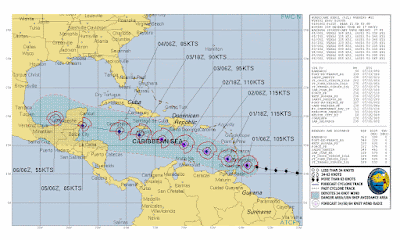
1 July 2024. Category 4 Hurricane Beryl tore through Carriacou on Monday morning, destroying 98% of its buildings, cutting its electricity, water supply and mobile phone coverage. Houses were reduced to matchsticks. Huge trees were uprooted. All vegetation was stripped away, turning the island from luscious green to brown. Several people (number still unconfirmed) died. Roads became impassable. All communication with the outside world was lost. To discover what had happened there, I turned to YouTube. There I discovered award-winning American journalist and ‘storm chaser’ Jonathan Petramala who had arrived on the island the previous day with colleague Brandon Clement to document the hurricane’s passage. His videos provided an absolutely remarkable record of the devastation.


Two decades earlier, when I had first sought information about Carriacou, YouTube was yet to launch. Today there are dozens of videos about the island. Petramala captured the ‘calm before the storm’ mere hours before the hurricane struck, incorporating drone footage illustrating the charm of its colourful buildings and its ‘paradise’ sandy beaches. His impassioned commentary heralded the calamity that was to come and, although the island’s one petrol station had closed after a run on fuel and the mini-mart was busy, there was no evident panic. “It’s going to be horrific,” he said … and it was.


The following day’s video was a bleak testament to the destruction Carriacou had endured. “This island is shredded,” Petramala commented. “These people are in desperate need of help.” A resident said: “Right now, Carriacou is finished for a couple of years.” I had never seen anything weather-related as shocking as the complete devastation shown here. It resembled a war-zone. The drone shots were heartbreaking. Another shell-shocked resident said: “The thing is: we have three [storm] systems right behind it. What about the people who don’t have the time to recover, who don’t have a roof over their head, who don’t have the resources to rebuild?”

This video was unique because communications (mobile, internet, radio) had been completely lost on the island in the hurricane’s aftermath. Carriacou has no TV station and its two local FM radios (‘Vibes 101.3’ and ‘Sister Isles 92.9’) had been knocked out. Using a vehicle battery, Petramala uploaded his video via the Starlink satellite. That Tuesday, there was no other footage online. Residents could be seen filming on their mobile phones but there was no signal coverage to share or upload videos and no electricity to keep their phones charged. The island’s population was in an evident state of shock. Petramala’s footage, in which he made repeated appeals for outsiders to help the population, was used in weather stories broadcast by television stations the world over to illustrate the disaster, deservedly garnering millions of views.

The next day, Wednesday, roads in the capital had been partially cleared by residents, allowing Petramala to explore beyond by vehicle. His next video showed the ‘Dover Government School’, designated as one of eight emergency shelters on the island, entirely reduced to rubble. Those who were sheltering there had to evacuate to its tiny library outbuilding completed in April 2023 that remained standing. In March 2023, the 40-bed Princess Royal Smart Hospital had reopened in Belair with fanfare as the island’s sole hospital after having been “retrofitted to improve [its] resistance to disasters like hurricanes”, using funds from the UK government and Pan American Health Organization. This video showed all its facilities unusable due to water damage.

Then, arriving at the government’s Emergency Operations Centre on Carriacou, also in Belair, Petramala explained to its seemingly baffled staff:

“I’m the only journalist on the island. We have a Starlink [satellite terminal] so we’ve been able to get in touch with the government down in Grenada. I think we’re the only people who have contact with the outside [world]. They want to be able to get in touch with you guys but nothing is working. … We can set [Starlink] up outside and give you guys ten minutes if you want to call down to the government in Grenada and communicate what has happened here.”

Surprisingly, the Centre did not appear to be a hive of activity after such total devastation. We did learn that only five of the island’s eight emergency shelters had survived (for 9,000 population?). Although the building’s generator was powering lighting, its "communications hub" (as promised by the US Charge d'Affaires) had not survived the hurricane, despite this "fantastic facility" having only been completed in 2021 with US$3m funding from the US Embassy. Did we see a basic radio transceiver (even a retail amateur radio set) to provide SOME two-way inter-island communication? No. Did we see walkie-talkies used by emergency staff for intra-island communication? No. An apparent dependence on commercial mobile phone networks (operators Digicell and Flow) was, er, unwise when their towers prove so vulnerable to weather and power issues.

Set up in their vehicle, Petramala and Clement allowed nearby traumatised residents to use their Starlink satellite link to contact their loved ones overseas, leading to emotional scenes. Later that day, a helicopter landed at Carriacou’s airport, Grenada prime minster Dickon Mitchell emerged and, interviewed by Petramala, resembled a deer caught in headlights (commented my wife). He promised aid “from tomorrow” but proposed recruitment of volunteers from the mainland and assistance from other countries over guaranteeing immediate assistance from his government. For islanders who had no homes, no water, no electricity, no food and no petrol, with vehicles destroyed and roads blocked, the unfortunate impression was of a lack of urgency two days after the hurricane had hit. (Excellent silent drone footage of the devastation recorded by Clement fills six YouTube videos.)

While Petramala and Clement had been arriving in Carriacou on the eve of the hurricane, Belair resident Rina Mills had been similarly filming from her vehicle the calm that reined that Sunday before the storm (accompanied by Belair youth worker Shem ‘Ambassador’ Quamina). Employed by the Carriacou office of the ‘Grenada Tourism Authority’, Mills’ warnings about the impending disaster were stark and serious. With hindsight, this video (like her many others) was a testament to the beauty of the island though, within a few hours, it sadly became a historic record of how much habitat and infrastructure were about to be destroyed. Her exceptional knowledge of the geography, history and culture of Carriacou, combined with her informal conversations, made her videos compelling. She promised: “After the storm, we’ll do an update as well.”

However, the next day’s destruction of mobile phone masts prevented Mills from updating viewers until Friday, when her 24-minute live feed was managed only by climbing to a high point on the south of the island to connect over the horizon to an antenna on the mainland. Mills and her partner had lost their home, like many other islanders, and appeared in an understandable state of shock whilst cataloguing the “total devastation” of their island and five known associated deaths. It was a sad, upsetting video that acknowledged how precarious is our day-to-day existence, whilst also demonstrating the resilience of the population and its sense of community in the face of unprecedented disaster. The contrast with Mills’ chatty pre-disaster videos could not have been starker. Coincidentally, I heard Mills interviewed that weekend on the BBC World Service show ‘Newshour’ about Beryl’s impact on Carriacou.

Once partial mobile communication was restored on the island, Mills uploaded video previously recorded in the aftermath of the hurricane. In the centre of the capital Hillsborough, next to the destroyed Post Office, a mobile water desalination plant had been set up to offer free drinking water to residents. This vital resource had been provided by American religious charity ‘Samaritan’s Purse’ which amazingly had dispatched a DC-8 cargo plane to Grenada (video of landing) the day after the hurricane, loaded with materials (see video) to establish a field hospital, desalination plants around the island, foodstuffs, tarpaulins, clothing and bedding. Two dozen of its volunteers were airlifted to Carriacou and a barge was chartered the following day to bring the equipment there from Grenada. It was a much-needed vital resource at a time when Grenada government assistance was still not visible. “Hats off to Samaritan’s Purse,” commented Mills’ partner. “They were the first to get here, in my opinion.”

I had never heard of Samaritan’s Purse but was incredibly impressed by the scale and urgency of its work, operating a fleet of 24 aircraft and two helicopters from North Carolina. Video of a public tour of this DC-8 plane at the Dayton Air Show only days earlier demonstrated the huge volume of supplies it had carried. Its volunteers quickly spread across the island, distributing materials to residents from churches (Pastor Happy Akasie’s church in Brunswick in this video). By the following week, it had set up its second field hospital in Carriacou with doctors, nurses, medications and counsellors (see video). Despite the island’s hotels/B&B’s having been destroyed, the charity operates self-sufficiently, building its own accommodation and bringing food and water for staff. It seems to embody the fictional Tracy family’s ‘International Rescue’.

Towards the end of this video, Mills understandably rails against sightseers arriving by ferry from Grenada merely to video the destruction in order to attract ‘hits’ to their social media channels. One example of this was bizarre ‘Coleen AKA Bright Diamond’ from the mainland who appeared to enjoy her ‘day out’ on the destroyed island, travelling on the back of an aid truck, making inappropriate comments, drinking from a wine bottle in the back of a car and buying bottled beer. Afterwards, the Grenada government introduced vetting of ferry travellers to Carriacou to prevent further ‘disaster tourists’ consuming the island’s scarce resources. Fortunately, these self-promoting types were in a minority, overshadowed by the many people and organisations who arrived on Carriacou to genuinely help out.

British solicitor and author Nadine Matheson had been visiting her parents’ house on Carriacou when the hurricane struck and recorded this scary video of its almost total destruction. Once back home, she is recording informative updates on her parents’ situation and a fundraising effort to replace the house’s roof. The structure is now covered by a temporary blue tarpaulin which, like so many other properties, was donated by Samaritan’s Purse.

Meanwhile, videos published by the Grenada government since the disaster have proven a quite surreal soft-focus experience after the stark wholesale destruction visible in locally-made videos. After its prime minister (who is additionally minister for disaster management) visited the island, one video showed him standing on the wreckage of a resident’s home, looking wistfully into the distance, accompanied by soft tinkling music. Its editor seems to be a big fan of 1980’s Lionel Ritchie music videos. There is lots of footage of government officials in fluorescent vests talking to each other, pointing at the destruction and being interviewed explaining what WILL happen but – dare I say? – not much footage of action IMMEDIATELY to tackle this humanitarian crisis. Initially, the government's media focus (including its partly owned GBN television channel) was much more on the relatively minor damage suffered on the main island, rather than the total destruction of 'sister isle' Carriacou.

Watching hours and hours of government press conferences uploaded online, I was struck by the preoccupation with ‘process’ they exhibit, talking endlessly about which department and which officers are responsible, which meetings WILL take place and who reports to whom. This habitual use of the future tense is alarming when what should be stated was what had ALREADY happened and what was happening RIGHT NOW. The government’s adoption of the slogan ‘Carriacou and Petite Martinique Will Rise Again!’ for the disaster seems symptomatic of this somewhat wishful thinking. It raises the big question: WHEN? Electricity is unlikely to be restored to the whole island for many months. Petrol remains in short supply. The situation on-the-ground for islanders remains dire.

The government press briefing on 9 July, eight days after the hurricane had hit, promised: a 2,000-gallon water truck loaned by a company on St Lucia “will commence distribution to residents starting Wednesday July 10th 2024”; then “a second 1,800-gallon water truck loaned by the Barbados Water Authority is expected to arrive on Carriacou during the coming week.” Does Grenada not own one water truck? How have 9,000 people on Carriacou been expected to survive without government-supplied fresh water for more than a week? Why does the co-ordinator of Grenada’s ‘National Disaster Management Agency’ (whose last web site news update was three weeks ago), Dr Terence Walters, seem to consider in this press conference that distributing 2,000 food packages to residents (who number 9,000) five days after the hurricane hit was a satisfactory response?

Coincidentally, a mere four days before Hurricane Beryl hit Carriacou, a 120-page report entitled ‘Grenada: National Disaster Preparedness Baseline Assessment’ had been published by the ‘Pacific Disaster Center’. It concluded that:

“… results for Grenada showed significant multi-hazard exposure including hurricane winds, earthquakes, and volcanoes with nearly the entire population exposed. […] The assessment pointed to vulnerabilities due to Environmental Stress, Information Access, and Gender Inequality and significant deficiencies in coping capacity areas such as Air Support and Transportation Capacity indicating enhancements are necessary to bolster Grenada’s disaster response capabilities. Addressing these gaps, alongside targeted efforts to mitigate the identified vulnerabilities, will strengthen the nation’s overall resilience to disasters. […] Strengthening communication and information management systems is essential to support effective disaster response and comprehensive risk reduction strategies.” [emphasis added]

In 2019, the World Bank had allocated US$20m to be drawn down by Grenada to address natural catastrophes, but had noted in its report:

"[Grenada's] Institutional capacity for implementation [risk] is rated Substantial due to weak inter-institutional coordination and the lack of technical expertise. Implementing the proposed operation will require the integrated work of several actors at the national and local levels to move the proposed policy actions forward. This could result in scattered, low impact, and/or uncoordinated actions." [emphasis added]

Estimated damages and losses to Grenada's economy from its most significant disasters suffered between 1975 and 2018 were estimated by the World Bank to have totalled US$967m (at 2017 prices). Hurricane Beryl's financial impact is likely to be greater than these prior disasters combined, eclipsing the island's annual GDP several times. Evidently, the fiscal catastrophe of accelerating climate change not only decimates small economies such as Grenada's but cumulatively will precipitate a global diversion of resources away from consumption towards mitigation and repair of weather, temperature and sea level changes. 

It was evident in videos posted online that aid had quickly arrived from diverse sources: generous individuals, volunteers and groups on mainland Grenada, other Caribbean islands, the United Nations, France providing boats of supplies and troops on the ground (Grenada has no army), global charities. I watched a video of the French ambassador to Grenada interviewed whilst off-loading aid. Have I similarly seen the British high commissioner or governor general on Carriacou? Maybe I missed them. On 5 July, the UK provided £0.5m of immediate aid to Grenada and St Vincent, but will more substantial longer term assistance be forthcoming from the island’s former colonial power?

In 1983, the United States had sent 7,300 troops to invade and occupy Grenada because president Reagan chose to believe its newly built airport, funded partially by the British government, would be used to land Soviet bombers. 45 Grenadians were killed and 358 wounded. Today, if a major power were to devote similar resources to rebuild Carriacou quickly, its population might be able to endure the hardship it currently faces. However, despite residents suffering no electricity, water, food or a roof over their heads and with several emergency shelters destroyed, the government in Grenada has no current plan for significant evacuation of the island, preferring to remove only pregnant women, residents of old people’s homes and the hospitalised. How long are its citizens expected to survive when no cash is available from destroyed banks or ATM’s, forcing residents to make a four-hour round trip to the mainland? In 2024, these generous and stoic island people have been marooned in a hellish medieval landscape.

My dream of island-living is over for now. Carriacou can never be the same again. What will happen there is difficult to fathom. Its economy, seemingly reliant on retirees from the diaspora and small-scale tourism (independent travellers and two marinas of yachts) is ruined, forcing its people to make lifechanging decisions. Nowhere have I read that Grenada main island’s schools and sports halls have been opened to Carriacou refugees who have lost everything. At a time when thousands of its residents remain sat amongst the ruins of their dwellings, the Grenada government announced precipitously that:

“… the [Cayman Islands] Premier is extending an invitation to Grenadians who wish to work in the Cayman Islands, to return with her on Tuesday July 16 2024.”

The premier of this British Overseas Territory (population 85,000) was due to deliver aid relief to Grenada that day, but not before a further press statement had to hurriedly clarify that “no such offer was made during the courtesy call made to the Prime Minister of Grenada by the Premier of the Cayman Islands” and withdraw the implied invitation to potential economic migrants. Oh dear. (I recall when 8,000 refugees out of a population of 13,000 left the decimated Caribbean island of Montserrat following its 1995 volcanic eruption.)

I never got to visit Carriacou but, compared to the suffering endured presently by its resilient people, my regrets are insignificant. Watching the news from Carriacou engenders a sense of helplessness in the face of such overwhelming humanitarian need. I am highlighting Carriacou here only because it has been on my mind for two decades since receiving that fateful email from Kyak 106. The neighbouring islands of Petit Martinique and Union Island have been just as badly devastated by Hurricane Beryl. Though I am continuing to follow events in Carriacou, the mainstream media has inevitably moved on swiftly to other disasters elsewhere.

Observing the aftermath of this catastrophic event since 1 July has merely reinforced the devastating impact of ‘climate change’ us humans have foisted upon populations who have done nothing to cause it. Nobody on Earth can afford to ignore this issue because its effects will inevitably be coming to your corner of the world soon. Nobody will be immune. It is coming to get you, whether or not you choose to believe it is real. Voicing this eloquently was an emotional call-to-arms video (initially at https://youtu.be/oYn-XarQM3M but mysteriously deleted since) by United Nations climate change executive secretary Simon Stiell who is seen hugging his grandmother amongst the ruins of her home on Carriacou, his homeland.

After having viewed Beryl’s immediate impact from a helicopter, Grenada prime minister Dickon Mitchell had described the destruction as “Armageddon-like” in a press briefing and promised:

“We know it is not something that will happen overnight, but we certainly believe that in the next week to two and a half weeks we should have a complete clean up.”

Weeks later, new videos from Carriacou continue to show a post-Armageddon catastrophe that could last months and years for its beleaguered population.

POSTSCRIPT

On 27 Jul, this blog entry had suggested "Hurricane Beryl's financial impact [on Grenada's economy] is likely to be greater than these prior disasters [1975 to 2018] combined, eclipsing the island's annual GDP several times." The World Bank had previously documented that "damages and losses" from Hurricane Ivan in 2008 had amounted to 148% of Grenada's then GDP.

On 30 Jul, Grenada prime minister Dickon Mitchell, closing the 47th CARICOM heads of state meeting he hosted and chaired there, suggested that the country's early estimated losses from Hurricane Beryl would amount to EC$ 1,000,000,000 = US$ 370,000,000.

A back-of-the envelope calculation of this assertion:
* Grenada GDP = US$ 1,320,000,000 (source: World Bank)
* 98% of buildings destroyed or damaged in Carriacou & Petit Martinique (source: Grenada government)
* estimated population of Carriacou & Petit Martinique =  9,000
* estimated number of buildings (homes + businesses + public buildings) = 5,000 (wild guess)
* estimated impact on GDP = 28%
* estimated impact per building on GDP = US$ 75,500

However, the destroyed buildings included public schools, emergency shelters, Carriacou's hospital, post office and police station, each likely to cost millions to rebuild/repair. Additional costs include destroyed infrastructure such as island-wide overhead electric cabling, ports, marinas, airport, beaches, agriculture, fishing, environment plus lost tourism income (14% of Grenada GDP in 2019, source: UN).

24 June 2024

Teach your children well? : 1960s-1970s : vegetable-free adolescence, Camberley

 “How often do you wash your face?” asked the doctor.

“Like how?” I responded, uncertain about what he was enquiring.

“You know, with soap and water,” he clarified.

“Er, never,” I replied truthfully.

“Why not?” he demanded.

“Because nobody ever told me I needed to,” I said, somewhat embarrassed.

The doctor regarded me pitifully, imagining I must belong to a tribe of itinerant gypsies or have been raised by wolves. To the casual observer, my suburban home life appeared quite normal. Scratch the surface and you would have discovered that my parents had given me few of the ‘life skills’ that are supposed to be demonstrated to children. On this occasion, my mother had sent her teenage son to the family doctor in Frimley Road because his face had become progressively covered in spots. But neither she nor my father had ever instructed me how or when to wash. Once a week, I stood under the water in our modern home’s shower cubicle. If my face became wet while shampooing my hair, I merely dabbed it dry with a towel.

The doctor wrote a prescription for a liquid called ‘Phisohex’ which came in a large green bottle. After a few weeks washing my face twice daily with this cleanser, my spots magically disappeared, following more than a decade of cheeks shamefully having been untouched by soap. Did my mother acknowledge this shortfall in her parental duties? Of course not. This was but one aspect of her ‘hands-off’ approach to childrearing. She had enjoyed a good post-war education at Camberley’s girls’ grammar school in Frimley Road where she was likely taught conventional housekeeping and domestic skills in preparation for marriage. She was good looking and always dressed immaculately in the latest trends. Her parents had raised her and her two sisters impressively. So where had her own parenting regime gone awry?

Most of the basic skills I developed – writing, reading, arithmetic – I learned from books and television rather than parental instruction. However, one ability that proved impossible to appropriate in that way was tying shoelaces. As a result, at junior school, after ‘PE’ (Physical Education) lessons that required us to change into slip-on plimsolls, I always had to seek out my cousin Deborah in the year below mine to ask her to retie the laces on my shoes. Once I progressed to grammar school, my skill deficit became more difficult to hide. The mandated school uniform required black lace-up shoes. My mother acknowledged my ‘shoelace’ issue but, instead of simply demonstrating how to do it, she bought me slip-on 'Hush Puppies' shoes for school which resulted in regular disciplinary action. Finally, I had to draft an embarrassing letter from my mother to the school, asking for her son to be excused from the dress code due to difficulty finding suitable lace-up shoes for his high in-step feet.

Like many 1960’s housewives, my mother regularly cut out recipes from magazines and stuffed them in a kitchen drawer. She was particularly proud of a plastic box with transparent lid holding two rows of Marguerite Patten recipe cards that she had sent for to ‘Family Circle’ magazine and which I was tasked with keeping in correct order. She loved making cakes and had a sweet tooth that probably promoted the development of diabetes in her later life. However, her skills with main meals were limited and she preferred to rely upon ‘instant’ foods like fish fingers that were heavily marketed to ‘busy’ housewives at the time. This was probably why I remained as thin as a rake during my childhood, despite teenage years spent scoffing two bowls of cereal both morning and night.

I had been a regular visitor to the family dentist on Middle Gordon Road due to the dreadful state of my teeth. Even at a tender age, I was being gassed for extractions. On one occasion, the stern dentist accused me of not brushing my teeth sufficiently firmly to prevent decay. I resolved to use the state-of-the-art electric toothbrush in our family bathroom with greater pressure during twice-daily cleanings. I returned to the dentist six months later, only for him to inform me that I had rubbed away most of the enamel from my remaining teeth. The outcome of his ‘advice’ was merely more extractions. Not once did this dentist question my mother about her children’s diet. Even if he had, she would have been unlikely to respond honestly.

My mother had an inexplicable lifelong aversion to vegetables. Only the humble potato would accompany our meals, usually in the form of Cadbury’s ‘Smash’. Carrots? Never. Peas? Nope. Broccoli? Unseen. There were other foodstuffs we never experienced – spaghetti, yoghurts, condiments, rice – because my mother had a preference for jellies, custard and blancmange, but it was the lack of vegetables that must have impacted our health growing up the most. I never understood how, despite the piles of women’s magazines around our home, she somehow studiously avoided taking their practical advice regarding suitable family diets. Such behaviour could have been excused earlier in the twentieth century when literacy and knowledge were less prevalent, but surely not by the 1960’s.

Much of my childhood during weekends and school holidays was spent at my maternal grandparents’ adjoining house where I helped prepare ingredients for their meals. Instructed by my wonderful grandmother, I would sit on the backdoor step with a bowl between my knees, shucking peas from their pods. I would use a peeler to remove the skins from various vegetables whose names I did not know. I would carefully place dozens of apples in rows within cardboard boxes, separating each layer with old 'Daily Sketch' newspapers before carrying them into the recesses of the house’s darkened larder under the stairs. My grandmother loved to make jams with these fruits, for which I carefully wrote out white adhesive labels carrying the manufacture date and type. Bizarrely, none of these vegetables or jams were ever served in our own house next door.

From the day she left school at twelve until the day she finally retired, my grandmother worked in fruit and vegetable shop ‘H.A. Cousins & Son’ at 11 High Street on the corner of St George’s Road in Camberley. During all those decades, her ‘sales assistant’ job never changed, standing all day on the shop’s bare floorboards, putting requested items in brown paper bags, weighing them on old-style scales against combinations of various brass weights, calculating the cost in her head and then the correct change to return to the customer.

Shop owner Mr Cousins would daily travel thirty miles to the fruit, vegetable and flower markets in London at the crack of dawn, returning with a van of produce to sell. Once a day’s stocks were sold, that was it. Any produce left over would be given to the shop staff. My grandmother regularly brought home quantities of all sorts of fruit and vegetables which she shared with us, though my mother always refused the vegetables. Thankfully, she did accept the fruit which became the sole source of my necessary five portions per day.

Cousins advertised its shop locally as “by appointment to Staff College” ('Sandhurst' Royal Military Academy), providing “Dessert Fruit and Flowers for Dinner Parties, etc.” Its upper-class customers and Sandhurst’s foreign residents necessitated it stock a variety of exotic fruits, the excess of which ended up in my family’s fruit bowl. Visitors to our house in the 1960’s were shocked to see pineapples, mangoes and lychees on our dining table, delicacies that I enjoyed as ‘normal’ long before their availability in supermarkets.

My mother insisted that fruit always be eaten covered in sugar, her favourite ingredient. Cups of tea required two spoons of white sugar, coffee two lumps of Demerara sugar, stewed apples or pears served frequently as our dessert had to be sprinkled with granulated ‘Tate & Lyle’. Even when I visited my mother in her final years, she would buy in a banana to offer me (she refused to eat them), accompanied by a plate of sugar in which to dip it. Thanks, mum. Banana yes, sugar no.

When my grandmother reached the statutory retirement age of the time, we all went round to her house for a little celebration of her departure from a lifetime of work on Cousins’ shop floor. She was pleased to be able to retire before Britain switched to decimalisation in 1971 as she feared metric calculations that no longer involved farthings, florins, half-crowns and guineas. Months later, the shop asked if she would return and work part-time because it was short-staffed. Of course she agreed. In total, she clocked up more than half a century working for that one employer in that one location, a 400-metre walk from her sole marital home.

In 1976, on arrival at university, the bulk of my Surrey County Council grant had to be paid in advance for one term of accommodation and three meals per day within college. Having never taken school dinners and rarely eaten out in restaurants, I was unfamiliar with the canteen system where you line up and tell the kitchen servers which food you want. I hardly recognised any of the foodstuffs on offer and would often merely opt for two identical desserts, skipping main courses entirely. Most intimidating were twice-weekly ‘formal dinners’ lasting an hour, during which more than a hundred students remained seated at long benches in the huge dining room to be served by staff a succession of courses completely foreign to me. The table places were laid with radiating lines of various cutlery, none of which I knew their specific purpose. My fellow students seemed to find all this ‘etiquette’, including ritual table-banging and foot-stomping, perfectly normal because 90%+ of them had grown up around such ‘practises’ at elitist private schools. I often avoided these ghastly events and sat in my room munching a packet of biscuits.

My parents having never taught me how to use cutlery, I had developed my own system whereby I always used my right hand to hold the fork. Only when I had to cut up some food would I transfer the fork to my left hand and then simultaneously use the knife in my right hand. The rest of the time, I placed the knife down on the table. Nobody had ever corrected me. Not until sitting in that university dining room, surrounded by loud toffs with posh accents and double-barrel surnames, did I have to learn to eat holding the fork in my left hand. To this day, my default way of eating is to grab the fork with my right hand. Old habits die hard.

In 1986, my little sister was offered a Saturday job on the till of a small self-serve fruit and vegetable shop in Camberley town centre. She was worried that she would not recognise the produce she would be expected to ring up, since our mother had never fed us veg other than potatoes. By then, I had spent a decade living away from our vegetable-free home and was able to accompany my sister on a ‘Secret Squirrel’ mission to the shop, during which we walked slowly around its one central aisle and tried to identify the varieties of common vegetable on sale. ‘Common’ to everyone else, particularly to our beloved late grandmother, but weirdly not at all to us!


In retrospect, my childhood must have been quite unusual because, although I lacked some basic life skills, I was steeped in other abilities beyond my age. By junior school, I had taught myself to type, to read music and play the piano (despite having non-musical parents). Having recruited me into his business once I could walk, my father taught me how to survey a property, create architectural plans on a drawing board, use Letraset, calculate floor areas and room volumes, prepare client invoices and statements on an electric typewriter, photocopy and make dyeline prints [see blog]. Meanwhile, my mother enrolled me into reconciling her employer's accounts and calculating its staff's pay packets [see blog], pinning and cutting dress patterns to materials, basic knitting stitches, using her sewing machine and threading multiple yarns on her knitting machine. I was eight when typing the forms for my parents' passport renewals, testing my mother's knowledge for her driving test and testing my father for his pilot licence. By the time I started secondary school, I was holding the fort at my father's town centre office, learning shorthand from my mother's discarded 1950's text books and calculating potential profits of deals for my father's new property business [see blog]. What a strangely un-childlike childhood it was!

20 June 2024

… and the award for car-crash Olympic flame live TV coverage goes to … : 2024 : La Premiere, French Guyana

 1995. The evening weatherwoman was standing in front of a wall map of the nation, reading the forecast for tomorrow’s conditions. In her hand were symbols for rain, sunshine and cloud that she went to place on relevant locations on the map. The icons remained there for no more than a few seconds before tumbling noisily to the floor. She bent down to pick them up and attempted once again to attach them to the map … with the same outcome. She soldiered on bravely until her script was completed in front of a wholly symbol-free map, then turned towards the camera with a weary farewell gaze that communicated: ‘why do I have to work with this rubbish technology?’

Was this ‘malfunction’ happening every evening on the Kenya government’s national television channel? I recognised her supposedly magnetic symbols from having watched nightly ITV regional weather forecasts during my childhood in Britain. Perhaps her masters had purchased a ‘job lot’ of second-hand apparatus from a classified advert in the back pages of ‘Broadcast’ magazine placed by one of those lazy UK commercial television stations that had eventually had their ‘licence to print money’ removed by the regulator. Wincey Willis, all is forgiven.

2014. I was lodging in a small town in southern Spain over the New Year. Just before midnight on 31 December, I impetuously took a ten-minute walk from the rented apartment to the main square to observe how the noisy Spanish were celebrating the impending change of calendar. There I found … they weren’t. Christmas decorations strung across the streets were fully illuminated, but not a soul was to be seen. In the town square, you would have heard a pin drop. It was eerie in a community of 15,000 to encounter deafening silence on entirely vehicle-free, human-free streets. Did the Spanish’s ‘reluctance’ to exert themselves (long daily siestas, shops closed during summer afternoons, holidays lasting weeks) extend to New Year’s Eve celebrations? I returned home, mystified.

There, switching on Spanish television, I caught a typically abysmal live variety show welcoming the New Year by parading a succession of uninspiring musicians and poorly choreographed dancers in front of a studio audience. Like so much of Spain’s TV, this circus was fronted by a male presenter whose suit seams were suffering immense stress and a young woman dressed like a high-class prostitute who would obligingly laugh loudly at her co-host’s every witticism. At twelve o’clock, the two of them indulged in Spain’s tradition of gulping down one grape at each of the twelve strokes of the midnight bell. For this, you can buy tiny cans of precisely twelve grapes in Spanish supermarkets.


Naturally, both presenters found utterly hilarious their inability to successfully complete this annual task, sat on their over-high bar stools. Then, amongst all the fake joviality, it became evident that the woman had wet herself and it was visibly trickling down her inside legs below an over-short, sparkly dress. What impact did this have on proceedings? None whatsoever. Everyone involved carried on as if nothing at all had happened. It was yet another of those television moments when you begin to question whether you really did see something THAT ‘abnormal’ on your TV. ‘Entertainment’ arrives in strange forms in Spain (The Inquisitions?) so, for all I know, she was probably invited back the following year.

2024. I have been lucky enough to be in France witnessing the run-up to the Paris Olympic Games. On 9 May, as the Olympic flame arrived in Marseille by boat from Greece, the French state broadcaster launched an online television channel dedicated solely to the impending event. Presently, the flame is passing through 68 of France’s 96 geographical ‘departments’, in each of which it is carried through streets of six or seven towns/villages consecutively by a relay of local volunteers walking/jogging around 200 metres each. In total, by the time the Games commence in July, the flame will have been carried during 68 days by 10,000 individuals through 450 of France’s 35,000 ‘communities.’

The new TV channel (confusingly named ‘Paris 24’ like longstanding news station ‘France 24’) offers around eight hours per day of live coverage of the torch as it wends its way up hills and down dales through France. The dominant visuals derive from Ronin Steadicam cameras held by two videographers sat facing backwards on the rear of peddle-powered tricycles, filming the torchbearer running towards them. This is supplemented by two scooter riders with lightweight cameras attached to their handlebars, a roving reporter interviewing people with another Steadicam, and two overhead drones. The vision mixer seems to be in situ (in a van behind the torchbearer?) and has a fondness for abrupt cutaways from the torchbearer, often of no more than a few seconds, as if directing an urgent pop music video. A bored male voiceover reads a script extolling the history of the town/village and the name, age and occupation of each volunteer carrier.

The results are often scrappy but make intriguing viewing. The satellite link occasionally fails, cameras temporarily lose their signals under bridges, inside buildings and when scooter riders collide with obstacles. There seems to be no ‘talkback’ facility, requiring camera operators to occasionally communicate using hand signals in front of their lenses. This coverage initially appeared somewhat amateurish, but quickly became addictive for this armchair viewer. What better way to visit so much of France’s rich land than the view from the back of a slow-moving tricycle? I have already accompanied the flame’s journey to mountain peaks above clouds, to caves of prehistoric art, across magnificently modern bridges, on kayaks down fast-flowing rivers and through historical theme parks. Watching the way France has beautifully maintained and restored its phenomenal history helps you understand why the majority of the French take their annual holiday within their country. There is so much to experience here!

Simultaneously, the sheer humanity on view has proven heart-warming in these ‘challenging’ times. Volunteers chosen to carry the flame have been of all ages, visually diverse and many with disabilities they have overcome to participate. One very elderly man with an arm in a sling shuffled along the route more than walked, taking an age to complete 200 metres, but was patiently accommodated. One torchbearer fell to his knees en route and proposed to his girlfriend as he passed her amongst bystanders. The crowds that have attended each stage of the torch’s journey have been huge and enthusiastic, particularly the hordes of children given the day off school to display the results of their Olympic Games art projects. There have regularly been very moving, spontaneous little moments that pre-scripted, sanitised television can never achieve.

On 9 June, the flame skipped out of mainland France for the first time to travel through the department of French Guyana in South America. I was very much looking forward to watching a travelogue through this little-known, far-flung outpost … until it emerged that, instead of coverage being mixed on-the-ground as usual by ‘France TV’ staff, responsibility had been inexplicably handed to the organisation’s local television station ‘Guyane La Première’. Instead of the focus remaining on the journey of the torch, the dozens of torchbearers and the communities passed, its station management turned this potentially historic outside broadcast into a studio-based programme. Had they not read the memo from head office? Had they not watched online the coverage of the torch journey to date? Or had they merely decided to do what the hell they wanted regardless? The outcome was predictably disastrous.

The TV station’s morning broadcasts omitted any live coverage of the flame arriving by boat in the village of Camopi at 0620 and its 1km journey through the town. The usual cameras and drones were on-site but their raw videography was edited down to an inadequate two-minute roundup repeatedly broadcast later in the day. The thrill of continuous live coverage had been completely lost. When the morning studio programme eventually started, it was led by a well-dressed man and woman (Nikerson Perdius and Geniale Attoumani) sat side-by-side at a desk covered in sheets of paper scripts. They appeared so under-confident that the man constantly shuffled their papers while the woman rung her hands. Occasionally, their eyes would meet with a look of ‘what the hell should we do next’. Instead of simply giving us the live feed of the flame, they viewed their role as interviewing their equally nervous two non-Olympic sportsman studio guests who used the airtime to complain about the lack of professional quality sports facilities locally. The studio presentation continued in this style for 90 minutes, repeatedly reading out the times and locations of the torch’s journey as if it were a radio show, but failing to show us more than sporadic visuals of the flame.

Unbelievably, after a break, the same two presenters returned for a further three-hour studio-based show that still failed to provide much live coverage. The flame’s 800-metre journey at 1110 around the huge high-tech satellite launching pad ‘space station’ at Kourou should have provided a great opportunity to appreciate Guyana’s technological significance. Instead, we saw almost nothing of the event because the presenters decided, at that critical moment, inexplicably to reshow the edited package of the flame’s early morning arrival at Camopi. I was moved to repeatedly shout at the television: “what the hell is the editor doing?” Much more important to the station were more endless studio chats with another set of non-Olympic sports guests. Just as bizarre were the live vox-pops with people on the streets who had observed the flame’s progress … instead of allowing us viewers to watch the flame’s progress first-hand.

Surely, the station’s afternoon coverage could not be worse? Don’t underestimate. Whereas the early shift presenters were under-confident, the afternoon team (Tamo Brasse and Charly Torres) appeared supremely over-confident, particularly in their own self-importance, one inexplicably wearing a ‘Tram Tours, Lisboa, Portugal’ tee-shirt. For 140 minutes, they talked and talked and talked with their sporting studio guests. The station’s on-the-ground contributors providing live commentary on the flame’s passage proved professional but were far too infrequently used. By now, my wife was also shouting at the television for the hosts to shut up because, once again, they seemed to imagine they were on the radio and left no space unfilled by their voices, instead of allowing us to view the live images and accompanying ambient sound. Ironically, whilst they chatted interminably, a large-screen TV was visible on the wall behind them in the studio, displaying the live feed of the torch’s progress … a visual they and their editor were preventing us from viewing.

In the evening, when the flame made its final journey of the day through the capital Cayenne, these same presenters returned for a further one-hour show. Now with two on-the-ground live reporters, this should have been a more satisfying viewing experience .. but wasn’t. The only reason they talked less animatedly and, instead, mumbled to each other was the absence of studio guests or their possible exhaustion. Suddenly, just when it seemed possible that we might view some uninterrupted live local coverage, the station inexplicably cut to a live feed of the European Athletics Championships women’s 100m semi-final from Italy in which French athlete Gemima Joseph was competing. By now, we were both screaming at the television: “the Olympic flame happens once in a lifetime in Guyana!”. (Incidentally, Britain’s Dina Asher-Smith won and Joseph came second.)

Could it get worse? Yes. The station was now interrupting its live coverage with pre-recorded packages, each lasting several minutes, about preparations for the Olympic flame’s arrival that had already been broadcast within the station’s two daily local news bulletins on previous days. Why choose this ‘filler’ when there is a once-a-century live event happening in your backyard? The icing on the cake for this unmitigated television disaster happened just as the flame was about to arrive at its final destination in the capital Cayenne where, at 1920, it would light the Olympic cauldron in front of a huge crowd. Twenty minutes before that, the two presenters folded their arms and, looking pleased with their performances, bade their audience a final farewell … BEFORE the flame had reached the crowning glory of its journey. Live coverage terminated. We screamed our heads off.

Had these presenters viewed the event as a once-in-a-lifetime opportunity to show off their chat skills beyond French Guyana on a television channel watched across mainland France? Were their efforts a pitch for some kind of longform chat show? Their station’s mediocre efforts were an insult to the many local volunteers carrying the torch, to the communities in Guyana it passed through, and to the hundreds of Olympic Games staff on the ground who enabled the torch to pass through the landscape. While the broadcasters had sat self-absorbed in their cosy TV studio, the hard work of on-the-ground videographers had been marginalised and mostly discarded. I tuned in wanting to actually see French Guyana and what I got instead were ‘talking heads’ in a studio. It was a disgraceful betrayal of everything the Olympics stands for.

Did nobody from state TV’s Paris HQ phone up and demand to know what the hell their employees in Guyana were doing? We will never know. Will heads roll? Unlikely because employment in France’s public sector is mostly a ‘job for life’. You would have to murder a client to be sacked. Watching television in mainland France, its output is filled with ‘the great and the good’ talking endlessly on studio panel discussion shows about anything and everything. It’s essentially cheap ‘talk radio’ programming parading as ‘television’.

Whenever ‘the system’ screws up in France, there are never apologies, never sanctions. Any problem is passed down to the user, the consumer, the citizen to suffer the consequences. The day after the Guyana station’s contemptuous Olympic flame coverage, ‘France TV’ HQ in Paris suddenly blocked online viewers from watching that local station’s live output. The many Guyanese living in France are now denied the ability to keep up with news from ‘home’, paying the price for their public servants’ failures.

Should you think my criticism is unfair on tiny French Guyana (population 295,385) for its efforts, six days later I watched the Olympic flame pass through Caribbean island of Guadeloupe (population 378,561) where coverage by its own outpost of the state television station ‘La Premiere’ proved absolutely excellent. Somebody there had evidently read and understood the memo.

[Sadly, links here to 'France TV' content may not work outside France.]

22 May 2024

The genesis of black music radio in London ... still unfulfilled : 1970-1984 : Radio Invicta 92.4

 I only knew 'Roger Tate' (real name Bob Tomalski) through listening to his programmes on the radio. He was a DJ on 'Radio Invicta', London’s first soul music radio station, launched in 1970. Invicta was a pirate radio station. Back then, there were no legal radio stations in the UK other than the BBC.

The notion of a campaign for a soul music radio station for London had been a little premature, given that no kind of commercial radio had yet existed in Britain. But that is exactly what Radio Invicta did. As Roger Tate explained on-air in 1974:

“Who are Radio Invicta? You may well be asking. Well, we’re an all-soul music radio station. We’re more of a campaign than a radio station, I suppose. We believe in featuring more good soul music on the radio.”

By 1982, 'Black Echoes' music paper reported that Radio Invicta was attracting 26,000 listeners each weekend for its broadcasts. By 1983, Radio Invicta had collected a petition of 20,000 signatures in support of its campaign for a legal radio licence. There was sufficient space on the FM band for London to have dozens more radio stations. By then, local commercial radio had existed in the UK for a decade. But nobody in power wanted to receive the station’s petition and Invicta’s Mike Strawson commented:

“I have tried to speak to the Home Office about it, but it shuts the door.”

Radio Invicta eventually closed for good on 15 July 1984, the date that the new 'Telecommunications Act' had dramatically increased the penalties for getting caught doing pirate radio to a £2,000 fine and/or three months in jail. By then, 'Capital Radio' had enjoyed its licence as London’s only commercial radio music station for eleven years. Its monopoly reign was still to run for a further six years.

It might have seemed in 1984 that Radio Invicta’s fourteen-year struggle to play soul music on the radio in London had come to absolutely nothing. The Invicta team went their separate ways after the pirate station’s closure. Roger Tate continued his career as a successful technology journalist. After his death in 2001, aged only forty-seven, one of his friends, Trevor Brook, spoke of Tate’s determination to play soul music on the radio in the face of opposition from the government and the radio ‘establishment.’ His eulogy at the funeral of his friend included these comments:

“The government told the story that there were no frequencies available. Now Bob was not stupid. He had enough technical knowledge to know that this was simply not true. So, either government officials were too dim to realise the truth of the situation ... or they were just lying. Nowadays, we have 300 independent transmitters operating in those same wavebands, so you can probably work out which it was. Anyway, in Britain, the result was that any proper public debate about the possible merits of more radio listening choice was sabotaged by this perpetual claim that it was impossible anyway.

So, we had pirates. Other countries which had not liberalised the airwaves had pirates as well, but some of them took the refreshingly realistic approach that no harm was being caused, and they permitted unlicensed operations to continue until they got round to regularising the situation. Ambulances still reached their destinations and no aeroplanes fell out of the sky. Not so in this country though. The enforcement services here were too well funded and the established orthodoxy too well entrenched. That 'frequency cupboard' was going to be kept well and truly locked!

Bob had thrown himself into running a regular soul station, Radio Invicta. He built a studio, tore it apart and built a better one. He eventually sectioned off part of the flat as a separate soundproofed area. He built transmitters - and got them working. But Bob was nothing if not multi-skilled, and he excelled in producing the programmes themselves. Using nothing more impressive than an old four-track reel-to-reel tape recorder, Bob would create highly polished jingles and station identifications. ‘Roger Tate, super soul DJ.’ Other stations, both official and unofficial, listened to what Bob and his colleagues did and their ideas were copied or imitated.

Faced with the authorities, Bob was remarkable, because he was absolutely fearless. He was certain they were in the wrong and, given enough time, were going to lose the battle. It was a war of attrition and only perpetual piracy was ever going to bring about change. And he was quite right about that. The government kept winning the battle in the courts but began to lose the moral one. Eventually the law was changed. 

Do we have free radio now? In the sense that anybody can decide to start up a new magazine, find the finance and get on with it, no, we don't have that for radio. The process is bound up with a longwinded regulation and approval process involving a statutory body which has had its fingers burnt in the past by the odd bankruptcy and the odd scandal. So they play safe and issue more licences to those who already have stations. The consequence is that originality and creativity get crushed into blandness and mediocrity. My own teenagers constantly flip between stations in the car, but they don't care enough about any of them to listen indoors. Fresh people don't get to control stations. Behind boardroom doors, they might think it privately, but in what other industry would the chairman of the largest conglomerate in the market dare to say publicly that even the present regime was too open and, I quote, ‘was out of date and was letting inexperienced players into the market’? That is a disgraceful statement. Where would television, theatre, comedy, the arts, and so on be, if new and, by definition, inexperienced people didn't get lots of exposure? The industry is stale, complacent and rotten. Bob, there are more battles out there and we needed you here.”

Ten years later, these words are just as pertinent. It is hard to believe that a bunch of enthusiastic soul music fans who wanted to play their favourite music to their mates could have posed such a threat to the established order. But the history of radio broadcasting in the UK has demonstrated repeatedly that ‘the great and the good’ consider the medium far too important to let control fall out of their hands. Their arguments, however ridiculous, were taken completely seriously because they were the establishment.

Peter Baldwin, deputy director of radio at the 'Independent Broadcasting Authority' [regulator], said in 1985:

“We wouldn’t want to be dealing with two current local stations [in one area]. If it’s Radio Yeovil [operating as the only commercial station in Yeovil], well, that’s okay ... But we couldn’t subscribe to competition [for existing local commercial pop music station 'Swansea Sound'] from Radio Swansea, unless it was in Welsh or concentrated on jazz – and there probably wouldn’t be sufficient demand for that kind of service.”

James Gordon (now Lord Gordon), then managing director of 'Radio Clyde', wrote in 'The Independent' newspaper in 1989:

“It has to be asked whether there is really evidence of pent-up demand from listeners for more localised neighbourhood stations ... Eight to ten London-wide stations would be enough to cater for most tastes.”

David Mellor MP told the House of Commons in 1984:

“The government do not believe that it would be sensible or fair to issue pirate broadcasters with licences to broadcast. To do so, on the basis suggested by the pirate broadcasters, would be progressively to undermine the broadcasting structure that has evolved over the years.”

However, within five years, the government did indeed license a pirate radio station to broadcast in London [see blog]. Once Invicta had disappeared in 1984, it was superseded by newer, more commercially minded, more entrepreneurial pirate radio stations – 'JFM', 'LWR', 'Horizon' – that played black music for Londoners. In 1985, a new pirate station called 'KISS FM' started, quite hesitantly at first. Its reign as a London pirate proved to be much shorter than Invicta’s but, by the time KISS closed in 1988, it was probably already better known than Invicta.

KISS FM went on to win a London radio licence in 1989 and re-launched legally in 1990 [see blog]. It carried with it the debt of a twenty-year history of black music pirate radio in London started by Radio Invicta and then pushed forward by hundreds of DJ’s who had worked on dozens of London black music stations. KISS FM would never have existed or won its licence without those pirate pioneers.

Sadly, the importance of KISS FM’s licence as the outcome of a twenty-year campaign seemed to be quickly forgotten by its owners and shareholders. The lure of big bucks quickly replaced pirate ideology during a period of history when ‘get rich quick’ was peddled by government as the legitimate prevailing economic philosophy. KISS FM lost the plot rapidly and soon became no more than a money-making machine for a faceless multimedia corporation [see blog].

Right now, there remains as big a gap between pirate radio and the licensed radio broadcasters as existed twenty years ago or even forty years ago. London’s supposedly ‘black music’ stations, KISS FM and 'Choice FM' [see blog], now sound too much of the time like parodies of what they could be. Whereas pirate radio in London still sounds remarkably alive, unconventional and creative. More importantly, only the pirates play the ‘tunes’ that many of us like to hear.

The issue of how black music was ignored by legal radio in London, and then betrayed by newly licensed black music radio stations, is on my mind because of my new book ‘KISS FM: From Radical Radio To Big Business.’ It documents a small part of the history of black music pirate radio in London, and it charts the transformation of KISS FM from a rag tag group of black music fanatics into a corporate horror story. I was on the inside of that metamorphosis and it was an experience that, even twenty years later, remains a sad and terrible time to recall.

In 1974, Roger Tate had wanted more black music to be heard on the radio in London. Ostensibly, that objective has been achieved. But the black music I hear played on white-owned stations in London (there is no black-owned station) is a kind of vanilla 'K-Tel' ‘black music’ that is inoffensive and unchallenging.

If Croydon is the dubstep capital of the world, how come there is no FM radio station playing dubstep in Croydon, or even in London? How come I never hear reggae on the radio when London is one of the world cities for reggae? How come I had to turn to speech station 'BBC Radio Four' to hear anything about the death of Gil Scott-Heron in May? Why is it that Jean Adebambo’s suicide went completely unremarked by radio two years ago?

Legitimate radio in London seems just as scared of contemporary cutting-edge black music as it was in the 1970’s when Roger Tate was trying to fill the gaping hole with Radio Invicta. Nothing has really changed. Except now there exists the internet to fill that gaping hole. And FM pirate radio in London continues to satisfy demands from an audience that legitimate radio has demonstrated time and time again that it doesn’t give a shit about [see blog]. Is it any surprise that young people are deserting broadcast radio?

Forty years ago, I listened to Roger Tate and London pirates like Radio Invicta because they played the music I wanted to hear. Forty years later, I find it absolutely ridiculous that I am still listening to a new generation of London pirates because they still play the music I want to hear. As Trevor Brook suggested at Roger’s funeral, our radio system is so consumed by “blandness and mediocrity” that “the industry is stale, complacent and rotten.”

Roger Tate R.I.P. You may be gone, but you and your campaign at Radio Invicta are as necessary as ever today. Sad but true.

[First published by Grant Goddard: Radio Blog as 'Radio Invicta: The Genesis Of Black Music Radio In London … Still Unfulfilled', 1 July 2011. Available as download.]

13 May 2024

Sacked by a boss desperate to steal my success : 1991 : Gordon McNamee, KISS 100 FM, London

 It was a little after seven o’clock in the morning when the phone rang. Normally, I would already have been out of bed by that hour on a weekday. However, the previous night’s ‘DJ meeting’ [open to all 44 KISS FM presenters] had tired me out. I was awake, but I was still trying to urge my body to get out of bed. The mobile phone stationed beside my bed rang noisily and forced my brain into action far faster than it wanted.

It was [KISS FM personal assistant to managing director] Rosee Laurence on the line, asking if I could schedule a meeting that morning with [KISS FM managing director] Gordon McNamee. I scrambled out of bed to retrieve my diary from the battered ‘WH Smith’ black plastic briefcase I always took to work. Requests for meetings at such short notice were common although, during the last few days, McNamee had had no contact with me. Laurence suggested ten o’clock. I explained that I already had an editorial meeting [of my programming department] scheduled for half past ten, but I could fit it in as long as the meeting was not going to last too long. She assured me that it would not. I scribbled “10am – Gordon” in my diary, replaced the mobile phone in its charger and got on with the business of waking up properly.

My diary told me that I had two further meetings that afternoon – a weekly sponsorship get-together at one o’clock with [KISS FM finance director] Martin Strivens [see blog] and the sponsorship manager, Gordon Drummond, followed by a debriefing session in the boardroom at three o’clock with KISS FM’s partners in the Pepsi promotion. During the drive from my flat to the office, I reflected on the possible reason for the early morning phone call. Was McNamee going to tell me what had happened at the previous day’s board meeting? Was he going to pretend that nothing untoward had happened and that the board had approved all his [unachievable] targets for Year Two?

I was already running late when I became caught up in the worst of the rush-hour traffic along Holloway Road. Although my work day officially started at half past nine, I liked to arrive at work earlier so that I could snatch a little time to myself before the inevitable mayhem started in the department. However, that day, there was only time to down a quick cup of tea before walking up to the top floor in time for my ten o’clock appointment. Gordon McNamee was sat in his corner office when Laurence ushered me in. After exchanging morning greetings, I sat facing McNamee across his huge wooden desk. He shuffled from side to side in his chair a few times, avoiding looking directly into my eyes, and he sighed unusually heavily. Several times, he looked up at me as if he was going to say something, but then stopped short.

I stared at him blankly, not knowing what to expect. Eventually, he started mumbling something apologetically, but still he was making little sense. I knew then that McNamee had bad news to break to me. He had always been excellent at whipping his team into a frenzy of enthusiasm when something good was happening, but he was almost incapable of breaking negative news to anyone. He started speaking slowly and managed to explain that he had been “extremely vexed” by the memo I had delivered to him two days earlier. ‘Vexed’ was one of McNamee’s favourite words to use in situations when somebody had done something that displeased him. Anyone else might have been angry, but McNamee was always ‘vexed.’

As he reflected upon the contents of my memo and how ‘vexed’ it had made him, McNamee seemed better able to talk to me directly and to break the bad news. He explained that the board had met the previous afternoon and had decided that the company no longer needed my services. He muttered something about this being the hardest thing he had ever had to do and how he regretted the decision, but I was barely listening to his words. Instead, I was thinking how cowardly was this man sitting in front of me. I was thinking that, even now, he had no intention of telling me the truth of what had taken place at the board meeting, or how he had probably acted to save his own skin. What I wanted to know was what he had told the board about my dissent and what he had told the board of my contributions to the station’s success.

But there seemed little point in saying anything at all to the cowering figure sat in front of me, with whom I had worked so closely for more than two years. I got up to leave the room. McNamee had failed to deliver my promised rewards on so many occasions that I did not need to hear another fabricated story about why I was not getting things to which I felt I was entitled. As I left his office, McNamee said that it would be necessary for me to leave the building immediately, and he thrust some documents into my hand. I walked straight out of his office, shocked that, even at this stage in our relationship, McNamee was still incapable of telling me truthfully why I had to go.

Before I could reach the staircase to return to my office, McNamee had caught up with me and was asking me to stop. For a second, I felt as if I should ignore him totally and just carry on walking, but I turned towards him at the very top of the building’s stairwell.

“We could say that you had resigned, to make it easier for you, if you wanted,” McNamee suggested to me.

I stared at him coldly with a combination of anger and hatred that I could feel welling up inside me.

“Gordon, that’s a fucking insult,” I spat at him. Then I turned and walked down the staircase leading to my office on the next floor.

I was incensed. After all the sweat, blood and toil I had poured into this company. After all the personal sacrifices I had made to ensure that KISS FM succeeded. After my hard work had produced the required results more quickly than had ever been anticipated [Year One target of one million listeners per week achieved within first six months on-air]. Now, I was being asked to resign from a job in which I had achieved nothing but success. McNamee’s cheek to even suggest such a thing had made me really angry. I was in a rage as I stormed into my office. The programming floor was starting to fill up, as staff trickled into work. My first thought was the speed with which McNamee had insisted I must leave the station. Rather than suffer the indignity of being forcibly removed from the building by the station’s security guard, I started to pack up my possessions.

[KISS FM head of music] Lindsay Wesker caught my attention as he walked onto the floor from the staircase. He was one of my senior team members, so I felt I should break the bad news to him personally. The only private place I could think of to talk was the men’s toilet in the stairwell of the floor, so we crowded into the tiny cubicle.

“I’ve just been sacked,” I said to Wesker, “and I’ve been told to leave the building immediately.”

Wesker looked thoughtful, but did not seem particularly shocked. I suddenly understood that Wesker must have been the only member of my team to know what was going to happen to me, before I did.

“Just as you’ve said before,” said Wesker calmly, “it’s always the programming department that gets the chop.”

These were the very words I had shared with Wesker more than a year earlier, during the first programme planning meeting I had convened at [former KISS FM office] Blackstock Mews. Wesker had mulled over my words carefully then and, now, I realised why he had found those words so interesting. In Wesker’s eyes, he had got rid of me at last [see blog]. I exited the men’s toilet without saying another word.

Having received no sympathy from Wesker for my predicament, I walked back to my office and continued assembling my personal effects. I had spent far more of my waking hours in that building during the last year than I had at home, so many of my own possessions were intermingled with that of the company. There was the portable television I had brought to the office when the Gulf War had started, there was a portable cassette player I used, the records I had used to make station jingles, and unread magazines that were cluttering the floor. These were all mine. I started gathering them together into a manageable pile to take away with me. Other staff on the floor noticed me through the clear plastic partition of my office and started to wonder what was going on.

I told Philippa Unwin, who had worked with me closely as the department administrator since the Blackstock Mews days, what had just happened to me. She became visibly upset. As I told other members of my team, they stood around the floor in disbelief and shock.

[KISS FM head of talks] Lorna Clarke said to me: “They can’t sack you just like that. You’re the only one who knows how this whole station works.”

I felt pressured by the urgency to get out quickly, so I started carrying boxes of my things down three flights of stairs to put in my company car parked at the back of the building. I suddenly realised that my hasty and unexpected departure from KISS FM could be explained away to the staff on any pretext, unless I could make some kind of statement myself. The memo that had ‘vexed’ Gordon so much had recorded all the significant events of the previous week, as well as having stated my unambiguous position on wanting KISS FM to adopt a realistic strategy for its future.

After less than a year on-air, one of the staff’s major criticisms was the lack of information about company decisions that trickled down to them from the senior management. Only those staff working most closely with me in the programming department understood that I was just as ill-informed about what was going on at board level as everybody else was in the building. Using a Prit-Stick from the top drawer of my desk, I glued a copy of my memo to Gordon McNamee onto the clear plastic partition of my office. My room opened onto the floor’s entrance lobby and the partition could be seen by everyone passing through the department. Alongside the memo, I glued the document detailing the programming policy changes I had been ordered by McNamee to devise.

While I continued to gather together my possessions, staff in the department started to read my two memos, all the while expressing outrage that my dismissal could be so abrupt. Then, Wesker burst into my office and handed me a sheet of ledger paper.

“Rosee [Laurence] upstairs says these things are KISS property which you have to give back before you go,” said Lindsay sheepishly.

Inscribed in red ink was a list:

“1) security tag 13-92 + ID pass.
 2) office & studio keys.
 3) car keys.” 

It was evident that Wesker had been anticipating my dismissal and was acting as messenger boy for the management staff on the top floor who were too cowardly to talk to me directly. I snatched the piece of paper from him, but ignored it. I asked him, rhetorically, how I was expected to take home all my personal possessions without being able to use the company car?

Before leaving the station for the last time, I walked around the programming department and said my hurried goodbyes to the few staff who were already at their desks. Because the majority of my team worked shifts, there were only a few people there. In the DJs’ office, [daytime presenter] David Rodigan was sat at his desk, facing the front windows that looked out over Holloway Road. His back was towards the office door, so I had to interrupt his preparations for that day’s lunchtime show to bid him farewell. He expressed outrage at my sacking and seemed bewildered by the speed with which I was being forced to leave.

There was nothing left to do except thank everyone who was in the department for the good times we had spent together and to give many of them one last hug. Some of the staff were crying, others were visibly angry, and some did not seem to believe the events that were unfolding right in front of their eyes. Wesker was the only person who seemed unmoved by the whole scene. He was busy protesting that I had not left the company’s property that he had been given responsibility to collect. I could not have cared less.

I got into my company car, half expecting someone to rush out and stop me driving it away. But they did not, and I drove away from the station’s car park for the very last time. I had arrived at work barely two hours ago. Now, I was already on my way home again. It felt as if some ghastly mistake had happened, some chance mishap over which I had been able to exert no control. I could not believe that this would really be the very last day I ever worked at KISS FM. The traffic was much lighter on the roads, now that the rush hour was over, so I reached home within half an hour. By then, I was feeling neither upset nor angry about my dismissal. More, I was stunned that the end could have come so abruptly, and without McNamee having offered any gratitude for my significant contributions to KISS FM’s success.

[Excerpt from ‘KISS FM: From Radical Radio To Big Business: The Inside Story Of A London Pirate Radio Station’s Path To Success’ by Grant Goddard, Radio Books, 2011, 528 pages]